
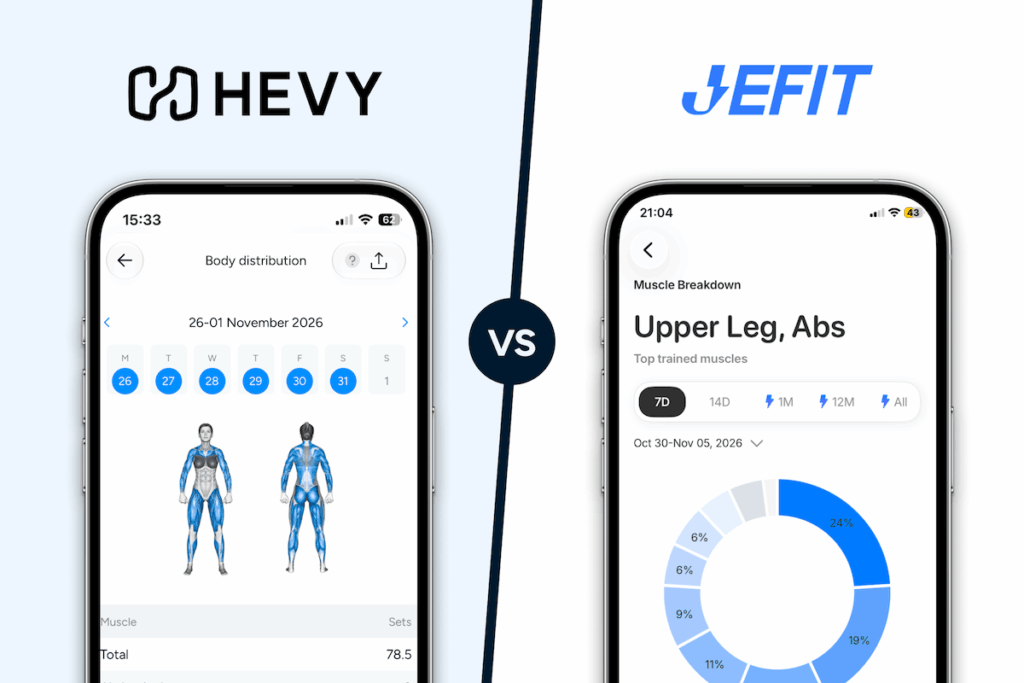
Jefit is a strength training platform built around a large exercise library and a catalog of pre-made routines from coaches and the community. It offers free workout logging with set-type toggles, supersets, circuits, and automatic rest timers, with the Elite tier unlocking its Adaptive Plan, AI progressive overload, and deeper analytics.
TL;DR
| Hevy | Jefit | |
| Best For | Lifters who want fast logging, long-term progress tracking, and a more affordable Pro tier with algorithmic, progressive programs in Trainer | Lifters who want a large exercise database, monthly challenges, and an Elite tier with a Progress Index and AI-assisted workout plans with progression |
| Pricing | $2.99/month $23.99/year $74.99/lifetime | $12.99/month $69.99/year |
| Free Version | Yes | Yes |
| Platforms | iOS, Android, Apple Watch, Wear OS, Web App | iOS, Android, Apple Watch, Wear OS, Web App |
| Logging Speed | Intuitive vertical layout with 1- or 2-tap set logging, inline RPE input, and an auto rest timer | Side-scrolling layout with 1- or 2-tap set logging, post-workout RPE, and an auto rest timer |
Jump to the summary and final verdict.
The Basics
| Element | Hevy | Jefit | Winner |
| Free version1 | Yes, unlimited logging, plus leaderboards, monthly reports, and 3 months of performance data | Yes, unlimited logging, plus challenges, leaderboards, body data, and basic progress tracking | Hevy1 |
| Price & plans2 | $2.99/month $23.99/year $74.99/lifetime No free trial | $12.99/month $69.99/year 7-day free trial; can redeem ‘Iron Points’ for a free week | Hevy2 |
| Platforms | iOS, Android, Apple Watch, Wear OS, Web App | iOS, Android, Apple Watch, Wear OS, Web App | Tie |
| Switching and lock-in | CSV export, import from Strong | CSV export (on web), no import | Hevy |
| Integration | Strava, ChatGPT, Claude, Apple Health, Health Connect | Strava, Apple Health, Health Connect | Hevy |
Free version1 (Winner: Hevy)
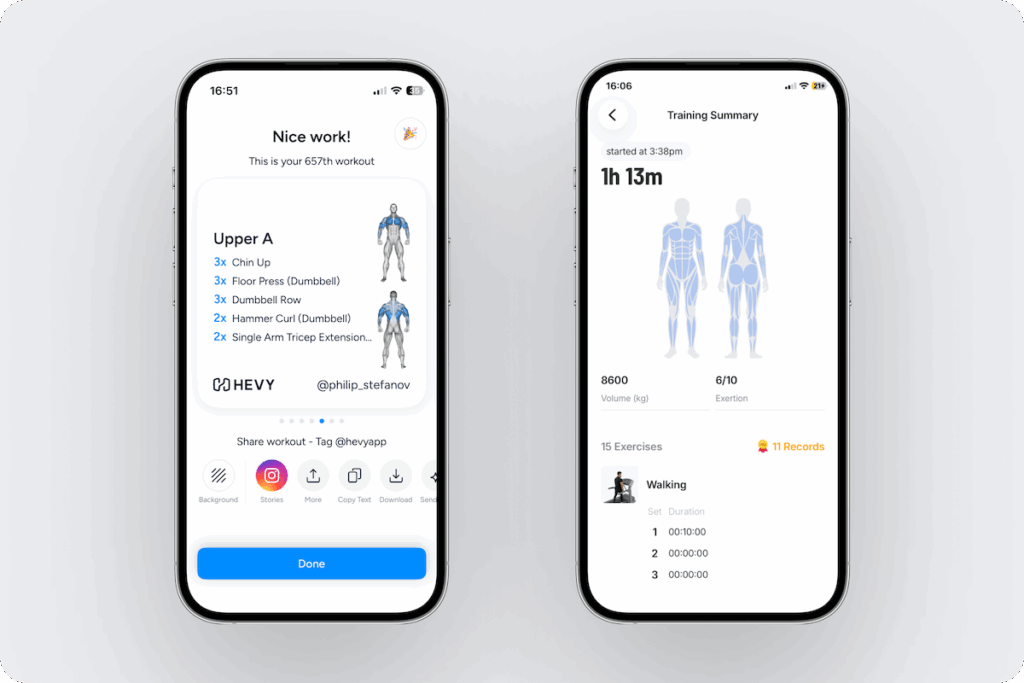
Hevy’s free tier is ad-free and covers almost all of the core lifting features.
Jefit’s free tier is also ad-free, though it does advertise its subscription more than Hevy does, and includes the full exercise library and plan catalog. Here’s how the two free tiers compare:
| Feature | Hevy | Jefit |
|---|---|---|
| Workout logging | Unlimited, including empty workouts | Unlimited, from plans, routines or Instant Workouts |
| In-workout tools | Per-set RPE entry, plate calculator, set-type toggles (warm-up, failure, drop) and auto rest timer | Post-workout RPE, set-type toggles (warm-up, failure, drop) and auto rest timer |
| Supersets and circuits | Yes | Yes |
| Exercise library | 450+ exercises with animations and instructions | 1,400+ exercises with videos and instructions |
| Routines and plans | Up to 4 saved routines, plus 26 splits and a routine library | 1 active plan (up to 5 routine days), plus access to specific free-tier coach and community routines |
| Custom exercises | Up to 7 | Up to 3 |
| Body tracking | Body weight, BF%, waist and progress photos | Body stats and progress photos |
| Performance data | PRs and graphs per exercise (including cardio pace, distance and time), Strength Levels for a wide range of exercises, and 3 months of performance and measurement data, including muscle distribution charts and a body heatmap | PRs per exercise, 1RM graphs (all-time), 7- or 14-day volume and muscle breakdown graphs, and muscle recovery estimates |
| Training calendar | Monthly, annual and multi-year | Monthly, opening into a yearly view |
| Motivation | Weekly streak counter, leaderboards, profile comparisons and monthly reports | Weekly streak counter, monthly challenges, leaderboards and achievements |
| Social | Social feed and discover page | Social feed and discover page with Q&A and meal plan sections |
| Data and integrations | Strong import, CSV export, Strava, Apple Health, Health Connect, and ChatGPT (importing more than 4 routines from ChatGPT needs Pro) | CSV export (on web), Strava, Apple Health and Health Connect |
Both apps let you train and track progress without paying. Hevy is more generous with custom exercises and reporting, and its 4 routines are standalone rather than tied to a single plan, while Jefit offers a much larger exercise library and community plan catalog. Hevy takes the category with a more generous free tier for managing your own training.
Price & plans2 (Winner: Hevy)
Hevy Pro removes the free tier limits on routines, custom exercises, and graph history, while extending muscle distribution and set count per muscle group charts beyond 3 months, and adding a warm-up calculator and algorithmic program generation with Trainer.
Jefit Elite unlocks unlimited plans and custom exercises, the full routine library, HD and slow-motion exercise videos, deeper analytics and the Progress Index, and AI-driven progressive overload. It also unlocks the Adaptive Plan (AI) after the first four weeks, which are free. Jefit Elite has a 7-day free trial and lets users redeem in-app Iron Points (earned through logging, referrals, and competitions) for a week of Elite.
Hevy is cheaper across the board, and its lifetime option is only slightly more expensive than Jefit’s yearly one ($74.99 for Hevy Pro lifetime vs. $69.99 for one year of Jefit Elite). Jefit’s trial and points system do make it easier to sample the premium tier for a limited time, but Hevy still wins on value for a lower cost.
Core Lifting Experience
| Element | Hevy | Jefit | Winner |
| Logging speed and UX1 | Vertical scroll, pre-filled values, option for empty workouts, inline RPE entry and auto rest timer | Side-scrolling, pre-filled previous values, no empty workouts, post-workout RPE, and auto rest timer | Hevy1 |
| Plate and bar weight calculator | Yes (free version) | None available | Hevy |
| RPE or RIR entry | Yes, inline entry (RPE, free version) | Yes, post-workout (RPE, free version) | Hevy |
| Supersets and circuits2 | Yes (free version) | Yes (free version) | Tie2 |
| Create and customize routines3 | Yes (add exercises, sets, weight, reps and rep ranges, rest timers, and notes) | Yes (add exercises, sets, weight, reps, rest timers, and notes) | Tie3 |
| Exercise library | 450+ exercises with demo animations, instructions, and information on primary and secondary muscle targets | 1,400+ exercises with demo videos, instructions, and percentage allocation for primary and secondary muscle targets | Jefit |
| Custom exercise creation4 | Yes (limited to 7 in the free version) | Yes (limited to 3 in the free version) | Hevy4 |
| Program library5 | Free library with 26 curated splits and numerous routine categories | Free and Elite library with official and community plans | Jefit5 |
| Progression and history6 | Yes (free and Pro) | Yes (free and Elite) | It Depends on What You Value6 |
| Onboarding and learning curve7 | Quick onboarding and intuitive interface for fast learning | Longer onboarding with questions for generated plan, soft paywall, and more complex learning curve | Hevy7 |
| Offline reliability8 | Almost fully functional | Functional, but several features require connection | Hevy8 |
Logging speed and UX1 (Winner: Hevy)
Hevy uses an intuitive vertical scrolling workout screen with previous weight, reps, and RPE appearing inline for each set. Repeating a set takes one tap, changing the values takes two. Once you’ve marked a set as complete, the auto rest timer will start. Hevy offers set-type toggles for warm-up, drop, and failure sets. RPE input is available per set, so you can track any deviations in effort across the whole session.
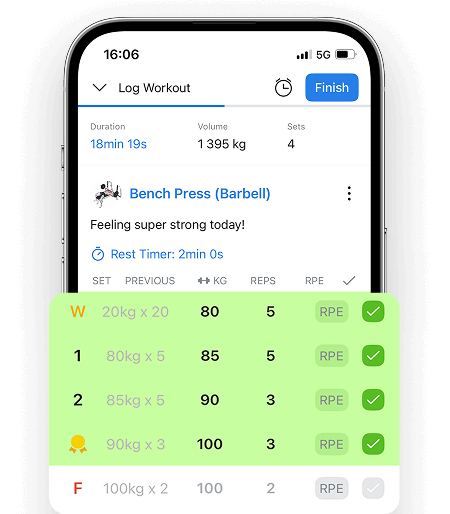
Jefit suggests weights and reps for you or adds the previous values, and supports 1- or 2-tap set completion; if you change the values, it will take two taps, same as Hevy. Its layout scrolls horizontally, with the exercise video positioned above the logging area. This can make the screen feel slightly cluttered. Jefit also supports set-type toggles for warm-up, failure, and drop sets. RPE is recorded after the workout on a scale from very light to maximal.
Hevy is a more convenient tool in a session: you can start an empty workout and build it as you go, and its simpler navigation makes it easier to run a session efficiently. It also offers per-set RPE entry and a free plate calculator, both covered in their own categories below.
Supersets and circuits2 (Winner: Tie)
Hevy allows you to create a superset or circuit by linking two or more exercises together by pressing + Add To Superset. Upon completing the first set, it will automatically scroll to the next exercise. You can unlink the exercise in the same way by selecting Remove From Superset.
Jefit enables the creation of supersets and circuits in a similar manner, though the side-scrolling layout makes it harder to see what’s up next. You add two or more exercises, and they will scroll automatically to the next in the superset.
Both support supersets and circuits on the free tier; because their capabilities are the same, the category is a tie.
Create and customize routines3 (Winner: Tie)
Hevy lets free users have 4 routines, while Pro offers unlimited ones. A routine can include exercises, set-type toggles, weights, reps or rep ranges, rest timers, and notes. You can also copy an existing routine to make a variation without rebuilding it.
Jefit’s free tier allows one active plan, with up to 5 routine days (and consequently up to 5 routines). You can add exercises, set types, weights, reps, rest timers, and notes, but it does not support rep ranges. Elite removes plan restrictions and adds more planning controls.
Hevy is more flexible, especially for maintaining different variations of training at once. Jefit is better if you want your routines organized inside your broader plan, and offers one more routine on the free tier. Both win on different aspects of routine management.
Custom exercise creation4 (Winner: Hevy)
Hevy allows for the creation of up to 7 custom exercises on the free plan and unlimited ones on Pro. You can add a photo, name, equipment, muscle groups, and one of several logging formats, including weighted and assisted bodyweight, duration and weight, distance and duration, and weight and distance.
Jefit allows three custom exercises for free and unlimited ones on Elite. You can add primary and secondary muscles, equipment, unilateral status, linked exercises, custom instructions, and record types, including weight and reps, reps, reps and duration, and duration-based cardio.
Hevy wins because its free cap is higher and its extensive exercise type options are better suited for unconventional logging such as carries, holds, or sled pushes.
Program library5 (Winner: Jefit)
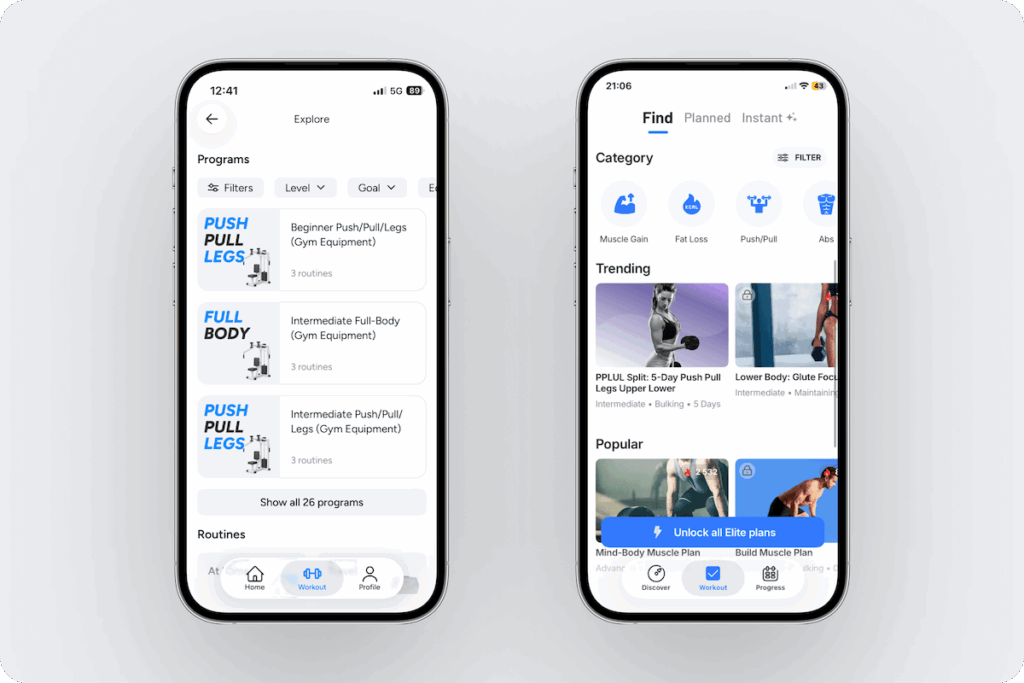
Hevy includes 26 curated splits and numerous routines, organized around goals and equipment, such as PPL, upper/lower, full body, dumbbells, bands, travel, bodyweight, and suspension training.
Jefit’s catalog is much larger and combines official, coach-created, and community programs and workouts. Categories include muscle gain, fat loss, PPL, abs, full-body training, home workouts, three-day splits, and stretching. Community routines are free; the full catalog of professional programs requires Elite.
Jefit is a better option for lifters who want to browse, sample, and follow many ready-made programs. Hevy’s smaller library is more curated, but contains significantly fewer options. If you’d rather have a program built around your goals, Hevy Trainer generates one (see Smart program generation below). Jefit wins this category.
Progression and history6 (Winner: It Depends on What You Value)
| Feature | Hevy | Jefit |
|---|---|---|
| Workout history | Full access to completed workouts with editable details | Full access to completed workouts with editable details |
| Training calendar | Monthly, annual and multi-year views | Monthly calendar that opens into a scrollable yearly view |
| Per-exercise graphs | Per-exercise graphs for heaviest weight, best 1RM, best set volume, best session volume, best time, total time and set records, plus best pace and longest distance for cardio | 1RM (up to all-time on free) and volume (Elite) |
| Overall training charts | Total duration, volume and reps over 3 months (free), or a year and all time (Pro) | Volume, workout time and muscle breakdown over 7 or 14 days (free), or 1 month, 12 months and all time (Elite) |
| Muscle analytics | Muscle distribution charts for 30 days or 3 months (free), or 1 year and all time (Pro); a body heatmap; set count per muscle group (Pro) | Muscle recovery % and recovery time |
| Strength benchmarking | Strength Levels that rank your lifts against other lifters across a wide range of exercises, including the bench press, squat and deadlift (free) | Benchmarking assessment that tests max push-ups in 1 minute, plank hold and bodyweight wall squat hold, then ranks you as a top % in your age group |
| Movement and balance analysis | Not available | Progress Index with 1RM change by pattern, stimulus volume, movement balance, vertical and horizontal push vs pull, and squat vs hinge graphs (Elite) |
| Reports | Monthly report comparing total workouts, duration, volume and sets with previous months | Report for each workout covering muscle focus, workout score, weekly sets per muscle and time breakdown (Elite) |
| Leaderboards | Leaderboard exercises | Monthly competitions with leaderboards |
| Other insights | Frequent exercises | Not available |
Jefit interprets more trends across movement patterns, muscle groups, recovery, and training balance, offering deeper analytics especially on the Elite tier. Hevy offers more per-exercise data and long-term history, but fewer overall insights. If you want detailed records you can review over months and years, Hevy is the better fit; if you want your training interpreted across movement patterns, muscle balance, and recovery, Jefit offers more.
Onboarding and learning curve7 (Winner: Hevy)
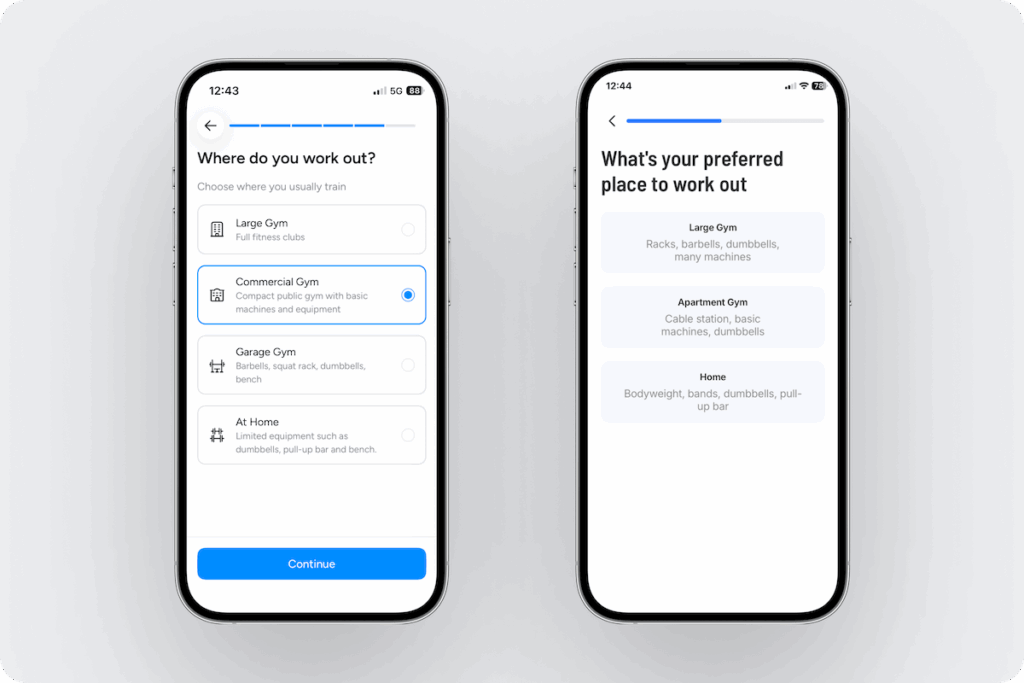
Hevy can get you from the download page into a workout quickly. The interface and logging flow are intuitive, and you can choose a premade routine, build your own, or start an empty session without working through an extended setup process.
Jefit asks more questions during onboarding to create its generated plan, and completing the questions triggers a soft paywall. Its broader feature set also means there’s more to learn, with plans, Instant Workouts, assessments, recovery data, Iron Points, and Elite-only tools all inside the core app.
Jefit can reward persistence with its depth, but Hevy is easier to adopt on day one, and its features are more intuitive to learn as you go. Hevy takes this category.
Offline reliability8 (Winner: Hevy)
Hevy remains almost entirely functional without a connection. You can log your sessions, open routines, view exercise guidance, and check previous performance; the main limitation is you can’t save a new split to your library. Data will sync when you are back online.
Jefit can handle core logging offline, but several useful features are missing without signal. You cannot browse routines, create workouts, view workout reports, access prior activity from the Progress tab, or check Iron Points.
For unreliable gym Wi-Fi or no signal, Hevy is the safer option, winning this category.
Intelligence and Program Generation
| Element | Hevy | Jefit | Winner |
| Smart program generation1 | Trainer (algorithmic) | Adaptive plan (AI) | It Depends on What You Value1 |
| AI features2 | No native AI, option for ChatGPT integration | AI plan and progressive overload | Jefit2 |
Smart program generation1 (Winner: It Depends on What You Value)
Hevy Trainer is a Pro feature that builds a complete strength program from your goal, experience, equipment, and personal details like height and weight. It creates workouts with exercises, rep ranges, and rest periods, and uses your logged performance to guide progression over time, with weight recommendations for exercises you have logged before.
Trainer includes a progress report that tracks total duration, sets, and volume, as well as muscle distribution, sets per muscle group, and body weight. It also includes the option to add deload weeks and any limiting injuries.
Jefit’s Adaptive Plan (AI) is more explicitly progressive. It runs through four-week mesocycles, with On-Ramp, Accumulation, Intensification, and Deload phases, and rebuilds your week each Monday based on the lifts you have logged. It also considers movement balance and injuries.
The first four weeks of the Adaptive Plan are available on the free tier, but progressing past that requires an Elite subscription.
The winner depends on whether you want a stable, algorithmic structure in Hevy or a responsive, AI-driven one in Jefit.
AI features2 (Winner: Jefit)
Hevy has no native AI features; instead, it offers integrations with ChatGPT and Claude that allow it to read workout data, answer questions, visualize progress, and create routines that can be saved to your Hevy account. The integration is free, but importing a plan with more than 4 routines requires Pro.
Jefit builds AI into its Elite experience. The Adaptive Plan and AI progressive overload tools within it adjust suggested weights and training based on your logged sets, and integrate that data into your analytics and periodization.
Jefit wins this category because its AI features are integrated into the training experience and work alongside your logged workouts. That said, Hevy’s ChatGPT and Claude integrations are free to use, so if you don’t want to pay for AI features, Hevy is the better option.
Social and Motivation
| Element | Hevy | Jefit | Winner |
| Social feed and community | Built-in social feed and discover page (can be disabled in settings) | Built-in social feed and discover page with Q&A and meal plan sections | Tie |
| Challenges and streaks1 | Leaderboards and weekly streak counter | Monthly challenges, leaderboards, weekly streak counter | Tie1 |
| Personal trainer integrations2 | Hevy Coach platform | Jefit Coach Mode | Hevy2 |
Challenges and streaks1 (Winner: Tie)
Hevy’s motivation is centered on consistency and comparison. You can track your weekly streak, view leaderboards against your friends on specific exercises, and compare your profile and lifts to people you know.
Jefit offers monthly challenges with a specific target, leaderboards that rank participants across the wider user base, achievements, and the Iron Points system that can be exchanged for a week of Elite. It also offers comparisons against specific users for total workout time and your bench, squat, and deadlift 1RM.
Hevy is better for comparison among people you follow, while Jefit is better if you want ongoing challenges and to compete against a broader group. The winner of this category depends on personal preference and how you approach accountability.
Personal trainer integrations2 (Winner: Hevy)
Hevy Coach is a separate platform and app for trainers, including client management, program building, a client chat, lead generation, team management, and in-person session logging. Clients train in the regular Hevy app, and their workouts and measurements sync to the coach dashboard.
Jefit Coach Mode runs inside the Jefit app and can be toggled on in Settings. You can onboard clients by email or username, assign plans from pre-built routines or create from scratch, edit plans in real time, and message clients. Coaches get a branded profile.
Hevy Coach is a more comprehensive business tool, with lead generation and team management, so it wins this category.
Trust Signals
| Element | Hevy | Jefit | Winner |
| Ratings and reviews | 4.9 on the App Store (390k+ ratings) 4.9 on the Play Store (285k+ ratings) | 4.7 on the App Store (85k+ ratings) 4.4 on the Play Store (90k+ ratings) | Hevy |
| Company maturity and updates | Active development with updates every week or so | Active development with updates every week or so | Tie |
Verdict
Across the 23 categories we compared, Hevy came out ahead in 12, Jefit in 3, the two apps tied in 6, and 2 came down to what you value. Hevy’s wins are across logging mechanics, pricing, offline reliability, the generosity of its free tier, data portability, ratings, and its coaching platform.
Jefit’s wins are the exercise and program library and native AI. The ties cover platforms, supersets and circuits, routine building, the social feed, challenges and streaks, and development cadence, while smart program generation and progression tracking come down to what you value.
| Choose Hevy if you want… | Fast logging, with per-set RPE entry, a free plate calculator, and empty workouts To train without a reliable signal: logging works almost entirely offline Detailed per-exercise progression, with PRs, leaderboards, and monthly reports A more affordable Pro tier with a lifetime option Algorithmic programming through Trainer that adjusts to your logged performance To coach clients and want a full business platform in Hevy Coach |
| Choose Jefit if you want… | A much larger exercise database (1,400+ exercises) A bigger catalog of official, coach, and community programs Deeper analytics, including the Progress Index, movement balance, and recovery estimates Periodized AI progression through the Adaptive Plan’s four-week mesocycles Monthly challenges and leaderboards against a broader group of lifters |
Other comparisons: