
What is a 5 Day Workout Split?
A 5 day split is a workout routine where you split your weekly training into 5 days, typically splitting each workout session into a different muscle group. This training method aims to maximize work on a specific muscle group during a training session, while giving it enough time to recover before the next session, typically the following week.
A 5 day workout split can be a big commitment, as you will be working out 5 days a week. It requires a lot of dedication in comparison to other workout programs, but when executed properly, can show great results. A 5 day workout split is like any other program however, you will still need to have consistent training, proper recovery and a great nutrition, in order to achieve your muscle building goals.
5 day splits can be organized in many ways as seen below. It largely depends on your fitness goals, and your schedule.
|
Classic 5 Day Split Day 1 – ChestDay 2 – Legs Day 3 – Rest Day 4 – Back Day 5 – Arms Day 6 – Shoulders Day 7 – Rest |
Upper Lower Push Pull Legs Day 1 – UpperDay 2 – Lower Day 3 – Rest Day 4 – Push Day 5 – Pull Day 6 – Legs Day 7 – Rest |
5 Day Split Variation Day 1 – ChestDay 2 – Legs & Shoulders Day 3 – Back Day 4 – Biceps & Triceps Day 5 – Core & Cardio Day 6 – Rest Day 7 – Rest |
As you can see, in a classic 5 day split (also known as a Bro Split), muscle groups are isolated into different training days. There are several variations of a 5 day split, some of which mix muscle groups into the same training session, others separate it by muscle movement such as Push Pull Legs and Upper Lower.


It’s also entirely up to you if you take 2 rest days during the weekend, or if you take one rest day between your weekly workouts, and then take the second rest day at the end of the week. People usually take the two rest days during the weekend as most people have full time jobs and it fits well into their work-life routine.
The Classic 5 Day Bodybuilding Split Workout Routine
The classic 5 day bodybuilding split is arguably the most famous routine for bodybuilders or anyone looking to put on a serious amount of muscle. They are intense training sessions targeting a specific muscle group and they are designed to pack on muscle. As previously explained, the workout split will be divided into 5 days, targeting the chest, legs (quads, hamstrings, outer/inner thighs, calves), back, arms, and shoulders.
Training Schedule
Day 1 – Chest
Day 2 – Legs
Day 3 – Rest
Day 4 – Back
Day 5 – Arms
Day 6 – Shoulders + Core
Day 7 – Rest
This workout schedule allows you to workout chest on Day 1 and allows you to not be totally fatigued in your upper body going into Day 2, which in this training split is Leg Day (quads hamstrings, outer/inner thighs, calves). We then have a rest after Day 2 from arguably the two heaviest training sessions.
Like previously said, you could also easily adjust this schedule to fit your work schedule and change the rest days to the weekend. A lot of people do this, and as long as you rest properly over the weekend, you should be nice and fresh for the new training week.
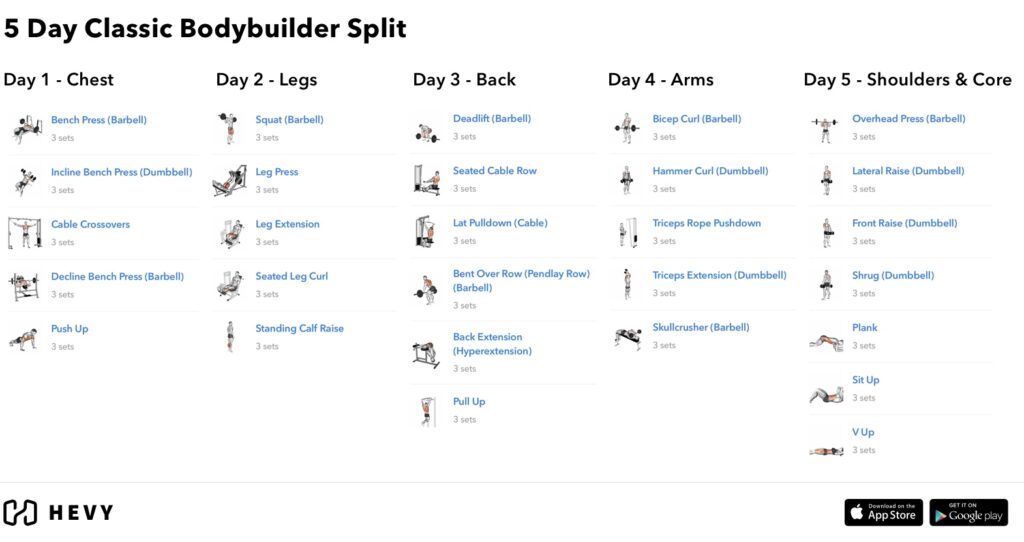
Below we find the actual workouts, with some predefined rep ranges for the given exercises. Start off with weights you are comfortable with, and go from there. You definitely do not want to be over training from the first week, just ease into it.
Chest
- Bench Press – 3 Sets (6-8 reps)
- Incline Dumbbell Bench Press – 3 Sets (8-12 reps)
- Cable Crossovers – 3 Sets (8-12 reps)
- Decline Dumbbell Bench Press – 3 Sets (8-12 reps)
- Push Ups – 3 Sets (8-12 reps)
Legs
- Squat Barbell – 3 Sets (8-12 reps)
- Leg Press – 3 Sets (8-12 reps)
- Leg Extension – 3 Sets (8-12 reps)
- Leg Curl – 3 Sets (8-12 reps)
- Standing Calf Raises – 3 Sets (8-12 reps)
Back
- Deadlift – 3 Sets (8-12 reps)
- Seated Cable Row – 3 Sets (8-12 reps)
- Lat Pulldown – 3 Sets (8-12 reps)
- Bent Over Barbell Row – 3 Sets (8-12 reps)
- Back Hyperextension – 3 Sets (8-12 reps)
- Pull Ups – 3 Sets (8-12 reps) Or as many as you can to finish the session!
Arms
- Bicep EZ Barbell Curls – 3 Sets (8-12 reps)
- Hammer Curls – 3 Sets (8-12 reps)
- Triceps Rope Pushdown – 3 Sets (8-12 reps)
- Triceps Dumbbell Extension – 3 Sets (8-12 reps)
- Skullcrushers – 3 Sets (8-12 reps)
Shoulders + Core
- Overhead Barbell Press – 3 Sets (8-12 reps)
- Lateral Raises – 3 Sets (8-12 reps)
- Front Raises – 3 Sets (8-12 reps)
- Dumbbell Shrugs – 3 Sets (8-12 reps)
- Plank – 3 Sets (30-60 seconds)
- Sit ups – 3 Sets (10-20 reps)
- V Ups – 3 Sets (10-20 reps)
This workout split includes exercises to target the main primary muscle groups, in addition to the many complementary muscles in your body. If you find yourself more comfortable with different exercises, or different variations of a movement, choose whatever works for your level of fitness, experience in the gym, and body mobility.
You’ll see we’ve added a core workout on the last session of the week on shoulders day. We like to end the week on an ab burn, but really you could be doing core exercises any of the other workout days and adjust it to your preference. We even recommend training core multiple sessions per week since it’s such a beneficial muscle group to prevent injury and promote a strong foundation for your lifts.

How to Gain Muscle with a 5 day Split Workout?
If you’ve settled on following a 5 day split workout routine and want to put on some muscle, we have some tips you can follow.
6-15 Rep Range
Many bodybuilders focus on performing between 6 and 15 reps for a given exercise to gain muscle. Higher rep ranges are considered as too light, and although you could be lifting for more reps and hence more volume, these are generally considered muscle definition rep ranges rather than generating muscle hypertrophy.
Progressive Overload
We’ve seen countless athletes stick to the same routine, with the same weights over months at a time. This is a rookie mistake you should look to avoid. Once you’re comfortable with the weight that you’re lifting, try lifting heavier and continue challenging your muscles. It’s fair to say that once you can lift a weight more than 10 reps for 3 sets, you should increase the weight for the exercise. Of course, you should make sure your form doesn’t suffer when increasing weights and that you perform the exercise safely.
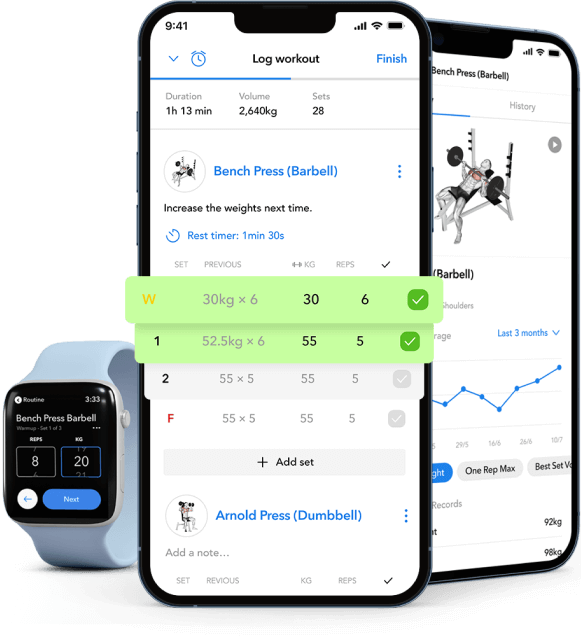
To properly perform progressive overload, we recommend tracking your workouts in order to keep a proper diary of your training. Of course, we recommend tracking your workouts with Hevy, to get in-depth analysis of your progression and history.
Short rests
We recommend taking between 60-90 second rests between sets in your workout. You should allow your muscles to take a short rest between sets to avoid complete burnout too soon in the workout, however you should also not allow your muscles to cool off completely. Wait between 60-90 seconds, and get back to the next set in order for the muscles to go through muscular fatigue. If you’re lifting extremely heavy weights in huge compound movements like a deadlift or a squat, your body might require more rest between sets.
Challenge your muscles
As Arnold Schwarzenegger said, “SHOCK THE SYSTEM!”. Your muscles will get used to doing the same routine over and over again. Change your routines from time to time, changing the exercises, the order, and the intensity of them. Don’t let your body get used to not being challenged.
Protein Rich Diet
Proteins allow your muscles to repair after they have been broken down and help you build muscle. Eating protein rich foods gives your body the necessary amino acids needed to rebuild muscle tissue. We recommend you doing some more research on this topic as we are not certified nutritionists to give an opinion on this topic.
Rest
During rest, your body responds by repairing and rebuilding the muscles that were broken down during training. This is what helps increase muscle mass. Your body repairs damaged muscles after intense exercise through a process known as muscle protein synthesis (MPS). Studies have shown that MPS works best 2-3 days after training a muscle group. The 5 day split routine provides plenty of rest for each muscle group in between training, maximizing MPS. If you do not give your body’s muscle groups time to rest, you risk overtraining them.
Who is a 5 Day Split for? Does it Fit My Goals?
When starting a new routine, many people come to the question: is this routine right for me? When you’re working out, you will be spending a lot of time and energy at the gym, especially for a 5 day split, so it makes sense to choose your routine wisely. It’s worth having in consideration how much time you have available, your level of experience and your fitness goals.
Beginners
Are you new to working out? If so, a 5 day split workout is probably not the best way to go. A 5 day workout split consists of working out 5 days a week, which requires a lot of dedication and time. If you’re new to weightlifting or bodybuilding in general, you might risk overtraining and injury.
In that case, it’s much better if you start with a workout routine which allows for more muscle recovery – for example: with a 3-day split. After a few months of training, once your body becomes used to the level of intense training, you can ease into a heavier workout routine, such as one that comprises four or five days of training.
The same applies if you have a particularly busy schedule. If you don’t find the time to spend five days a week at the gym, you probably shouldn’t be going for a 5 day split. Don’t sacrifice the quality of your workouts by trying to hurry them and potentially ruining your form. Training requires consistency, and you should see better results working out three days a week regularly, than working out five days a week once in a while.
Experienced Weightlifters
So, if the 5 day split is not for beginners, who is it for? If your goal is to build muscle, and you want to dedicate a lot of time to the gym, the 5 day split can be the ideal workout routine for you. This workout routine should also take into consideration the type of training and results you want to achieve. For example, if you’re only looking to increase strength, like powerlifters do, a classic 5 day split bodybuilding routine would not be for you, and you should be looking into a powerlifting specific training program. If you are working on aesthetics, you can look into a more aesthetic approach, such as Gironda’s 8×8 training.
As mentioned, working out five days a week takes a lot of energy for your body, so we recommend you recover properly to avoid overtraining.
Another use case for a 5 day split is if you want to lose weight. The consistent training sessions, along with cardio, will help you burn a lot of calories, and consequently help in losing fat as well. However, just remember the key to any plan is to train consistently!
Effectiveness of a 5 Day Split vs. a 3 Day Split
As you’ve probably picked up by now, there are a lot of split variants out there. So which one of them is the best for you? After all, why put your body through training for 5 days a week when a shorter program such as the 3-day split does the trick?
Many benefits come with a 5 day split workout routine that would be much harder to cover with a shorter variation, such as a 3 day workout split or a 4 day workout split, or a 5×5 workout plan.
Muscle Specificity
As the name suggests, the 5 day split routine is designed to make you work out for 5 days a week – typically a separate muscle group each day. This means that a 5 day split devotes more time and training volume to each muscle group and body part.
On the other hand, whilst you still aim to exercise every body part in a 3-day split, your area of attention is less focused. You need to train every part of your body within a shorter time span (in this case, 3 days), which means you’ll spend less time and volume on each muscle group. This is quite the opposite to a 5×5 plan, where you only do big compound movements, and repeat two workouts throughout your training.
Rest Days
A 5 day split routine means that you are hitting the gym 5 days a week, and have 2 days rest per week. A 3 day split routine means that you are training 3 days a week and have 2 days rest. You will obviously have more rest doing a 3 day split, which means this might be more suitable for beginners as you will minimize risk of overtraining and chance of injury.
5 Day Split vs. 3 Day Split: Which One Should I Choose?
Despite the differences, a lot of other factors come into play when choosing the right training routine. If you have a busy schedule with work, school, or other activities, it might be hard for you to stay committed to your training 5 days a week. You might also have a prolonged recovery time, which is influenced by several factors such as age, genetics, and lifestyle.
How Long Should I Follow a 5 Day Split to See Results?
Like all good things in life, noticing significant changes takes time. The fastest and the most obvious changes will initially show in your mental health. You might start a 5 day split with the goal of building muscle, but as you begin working out, the sheer act of physical activity will help improve your mood and energy through the day.

This can give you further motivation to continue working out. As weeks of training pass, your overall physiological health begins to improve as well. Your heart muscle gets stronger as it pumps more blood, which increases your stroke volume. Your blood pressure becomes more balanced and your aerobic fitness improves as well.
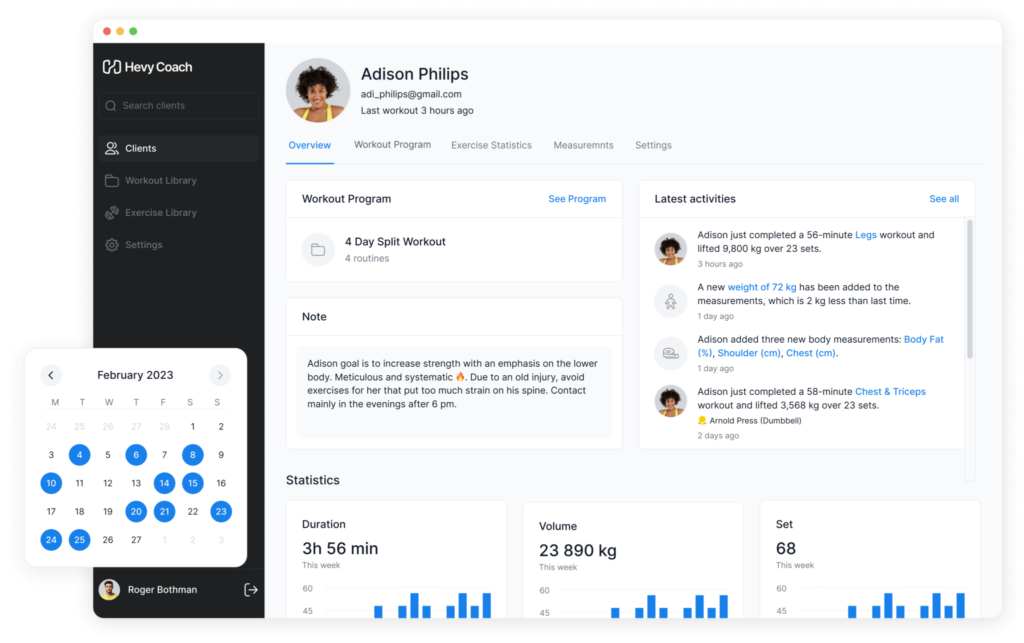
When it comes to muscle mass, you will need to wait a little longer. If you’re a beginner in training, your progress will be faster at first, and you’ll start to notice subtle differences within 6 to 8 weeks. As you work out consistently, you will start to notice significant results within 12 to 16 weeks. Of course, tracking your workouts and staying consistent will always help… shameless plug for Hevy 🙂
Like most training programs, only working out is often not enough. Usually, your results are influenced by several factors, which include exercise as well as diet and lifestyle. Your progress will depend on your training intensity, frequency, and quality of rest.
FAQ’s
What is a 5 day split workout?
A 5 day split workout is a training program that is designed so that you have to work out 5 days a week – focusing one (sometimes two) muscle groups each day. These split workout routines vary from program to program, but generally, your muscles groups are segmented into – chest, back and core, shoulders, arms, and legs. In some cases, the exercises each day are segmented differently – focusing on the upper body, lower body, push pull and legs.
The 5 day split workout program is incredibly popular with bodybuilders and weight trainers as it allows them to train each muscle group separately whilst offering plenty of rest for your body parts in between. This helps stimulate hypertrophy and muscle growth.
Since each muscle group is trained only once or twice a week, this also offers ample rest to your body parts to recover, which is when most of the muscle growth occurs. The 5 day split also allows for more variation in exercises, which helps keep things fresh in the gym. However, the 5 day split workout routine requires serious commitment in terms of time, and as a result, not all people can follow this program consistently.
How much rest should each muscle group get for muscle growth?
There are many 5 day split workout programs out there, and the structure varies from program to program. Generally though, all programs suggest that you train each muscle group at least once per week.
The 5 day split program allows you to perform high volume training per muscle group in a session, and then allow it to rest for the next 7 days until your next session. This gives your muscles plenty of time to recover. This is important because your muscles don’t actually grow while you work out, they grow during recovery.
Intense training on a particular muscle group twice a week can take a huge toll on your body, and leave little time for recovery. We recommend having stretching session from time to time, as this will help keep your mobility in check. As a beginner, you might risk not giving your body enough rest and risk overtraining.
If you’re thinking about rest in between sets or between exercises – that varies widely as well, depending on the workout routine you’re following. Roughly, it’s recommended you take between 1-3 minutes depending on the exercises, weight lifted, and your fitness goals.
As a beginner, should I do a 5 day workout split?
A 5 day split requires pretty intense training and is very hard on the body. If you’re new to weight lifting or even working out, you probably will overstress yourself. This means that you risk overtraining and injury. However, every person should evaluate this on a case by case basis. The most important thing as a beginner is developing the consistency of going to the gym and focusing on proper exercise form.
As a beginner, you might reap a lot of the benefits from working out without risking overtraining with a 2 day split or 3 day split. Once your body has adapted to working out and you want to increase your workout intensity, you can move to a more intense training routine like a 4 day split, 5 day split, or a 6 day split.
When doing a 5 day split workout, when should I do cardio?
Cardio plays a key role in your workout sessions. Whether you’re training for strength or to lose weight, cardio can help increase your endurance. Performing cardio exercises lowers health risks, improves cardiovascular endurance, and has plenty of mental benefits such as improving your mood – which helps to motivate you further.
When doing a 5 day split workout, most people face the question: I’m already working out 5 days a week, when should I do cardio?

Bodybuilders and trainees differ in terms of opinion. Some of them prefer to do a strength training session and a cardio session on the same day. Other people reserve cardio for their rest days instead. However, if you’re looking to develop strength and muscle mass, which is the case with 5 day splits, keeping your cardio and training separate would be better, as it gives you time for recovery.
Science backs this up as well. A paper published in James Cook University in Queensland, Australia suggested that weight training and cardio exercises on the same day can leave you fatigued. Instead, you should wait at least 24 hours in between exercises. So, as tempting as it is, keep your cardio reserved for rest days.
What is the difference between a 5 day Bro Split and a Full Body Split?
Oftentimes in the bodybuilding culture, a 5 day split is referred to as a Bro Split. It refers to segmenting different muscle groups and training one muscle group per session. This allows you to train each muscle group of your body in a very targeted way.
On the other hand, a full-body split, as the name suggests, concentrates on the entire body. In a full-body split (also known as full-body workout), you work out every muscle group in the body multiple times per week.
When it comes to muscle mass, both workout programs can be successful. However, each school of thought is very different. The Bro Split focuses on intense spikes in volume and longer resting periods, while full body splits focus on higher weekly volume per muscle group, given the higher frequency of training per muscle group.
Is working out 5 days a week too much?
In a 5 day split, you work on each muscle group of your body on a different day, so usually don’t even work out the same muscle group more than once or twice a week. Also, the 5 day split offers two rest days.
If you feel seriously fatigued, over several days, you can definitely scale back your training and take an extra rest day or two. You should also make sure to keep your nutrition to high standards, in order to recover your muscles properly.
Can I do a bodyweight 5 day split?
Absolutely! There’s no reason why you can’t. Many people may lack the budget or the time to hit the gym 5 days a week for months or years or purchase the necessary gym equipment at home.
There are many gym exercises that you can switch out with bodyweight exercises. For example, you can do pushups instead of bench presses or do bodyweight squats if you don’t have barbells.
What are the main 5 day split exercises?
The exercises in a split routine will vary from person to person, and program to program – depending on your goals. The main exercises for gaining muscle mass can vary greatly from exercises for losing weight. However, there are some common exercises for a 5 day split.
A 5 day split divides your workout sessions into several muscle groups such as back, chest, legs, shoulders, and arms. For your back, some popular exercises are deadlifts, lateral pull-downs, bent over rows, and dumbbell rows. For your chest and abs, you’re more likely to focus on bench presses, crunches, and pushups.
Leg day exercises can consist of squats, lunges, and calf raises. For shoulders, the main exercises are military presses, lateral raises, and barbell shrugs. Arm workouts consist of curls and dips and focus on your biceps and triceps.
How long should my workouts last in a 5 day split workout?
There is no absolute time period that you should be dedicated to a particular muscle group. How much time you spend in the gym will vary greatly – depending on your schedule and endurance. However, it’s important to remember to spend enough time with each muscle group so that you can maintain a balanced development of your entire body.
We estimate your workout sessions will vary between 60 to 90 minutes, including warm-ups and cooldowns.
The Bottom Line
In conclusion, a 5 day split workout can be a fantastic choice for your workout routine, whether you’re looking to get into better shape or on your way to become a bodybuilder. Granted, the 5 day split does pose some challenges for complete beginners, due to the intense workout sessions and serious time commitment. With enough dedication, 5 day splits can be a great training plan for increasing muscle mass.
There’s a reason why 5 day split workouts are a favorite for many bodybuilders. Even though you are hitting the gym 5 days a week, it allows for plenty of time to let your muscles rest before the next session in the following week.
Like any other workout program, you need to be training consistently to see results. This can be tough for people who do not have a lot of time to dedicate to training, resting properly and having the right nutrition.
If you choose to follow a 5 day split schedule, there are some things that you should keep in mind when working out.
- Start Slow – If you’re new at this, don’t feel ashamed to start with lower weights. Everyone’s progress will be different. Start with whatever is comfortable for you, and make adjustments gradually.
- Maintain Proper Form – It does not matter how much weight you start with, but remember to maintain proper form. Proper form will help you avoid injuries as much as possible and will improve your results.
- Maintain Consistency – Be consistent! A large part of your progress depends on hitting the gym regularly. Consistency is the most important factor when it comes to results.
- Keep Other Variables in Check – Exercise alone is not enough for muscle gain. You also need to keep your diet, sleep, and lifestyle in check.
We hope this guide helped inform you about 5 day split workouts! Be sure to check out Hevy and how it can help you track your training!




2 thoughts on “5 Day Split Workout – The Complete Guide (2024)”
This is what I was looking for. I’m 66. I got strength. I need size.
Thanks for this. I’ve been doing a 4 day routine for a while and wanted to go to 5 days. This is really helpful in explaining how I might do that.