
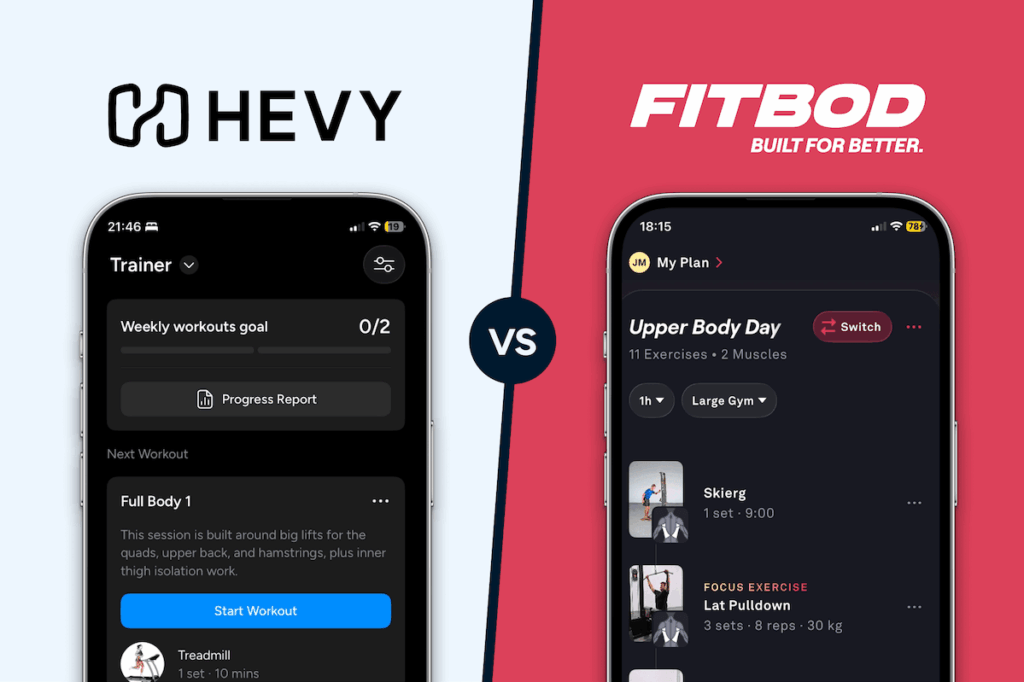
Fitbod is a subscription-only workout app that builds workout plans algorithmically based on your available equipment, experience level, and recovery data. It also provides exercise instructions and pre-calculated weights and reps, while automatically adjusting volume and exercise selection over time.
TL; DR
| Hevy | Fitbod | |
| Best For | Lifters who want fast manual logging and a complete coach-style training plan with progressive overload | Lifters who want algorithmically generated workouts that adapt to their progress and recovery |
| Pricing | $2.99/month $23.99/year $74.99/lifetime | $15.99/month $95.99/year |
| Free Version | Yes (ad-free) | No (7-day free trial only) |
| Platforms | iOS, Android, Apple Watch, Wear OS, Web App | iOS, Android, Wear OS, Apple Watch |
| Logging Experience | Clean interface, 2-tap set logging, previous weight and rep values pre-filled, and an auto rest timer | Intuitive pre-made workouts with 2-tap set logging, an auto rest timer, and pre-calculated weights and reps |
Jump to the summary and final verdict.
The Basics
| Element | Hevy | Fitbod | Winner |
| Free version | Yes, super functional | No | Hevy |
| Price & plans1 | $2.99/month $23.99/year $74.99/lifetime | $15.99/month $95.99/year Duo, Family, and Business subscription plans | Hevy1 |
| Platforms | iOS, Android, Apple Watch, Wear OS, Web App | iOS, Android, Apple Watch, Wear OS | Hevy |
| Switching and lock-in | Export as CSV, import from Strong | Export as CSV | Hevy |
| Integration | Strava, ChatGPT, Claude, Apple Health, Health Connect | Strava, Apple Health, Health Connect, Fitbit | Tie |
Price & plans1 (Winner: Hevy)
Hevy offers a free, ad-free app, plus paid Hevy Pro plans. Fitbod is subscription-only. When you sign up, you get a 7-day free trial, after which you must pay monthly or yearly. To use the app at all, you need to enter your payment details.
Hevy’s free tier includes logging and viewing unlimited sessions, up to 4 saved routines, 26 splits and various workouts in the routine library, up to 7 custom exercises, and 3 months of performance data; plus leaderboards and monthly reports.
Hevy Pro unlocks unlimited routines and custom exercises, plus features like Hevy Trainer. It offers monthly, annual, and lifetime subscriptions, whereas Fitbod only has monthly and annual options.
Fitbod has no free tier. It offers pricing plans for Duo (two people), Family (up to 5 people), and Business (up to 100 people), which Hevy does not. However, the monthly and annual prices are significantly higher than Hevy’s offering.
Hevy wins on price and accessibility because it’s cheaper across all tiers and is the only one of the two you can use for free indefinitely.
Core Lifting Experience
| Element | Hevy | Fitbod | Winner |
| Logging speed and UX1 | 2-tap set logging, previous values pre-filled, auto rest timer, minimal on-screen clutter | Pre-made workouts, 2-tap rep/weight logging, auto rest timer, exercise guidance, intuitive interface | Tie1 |
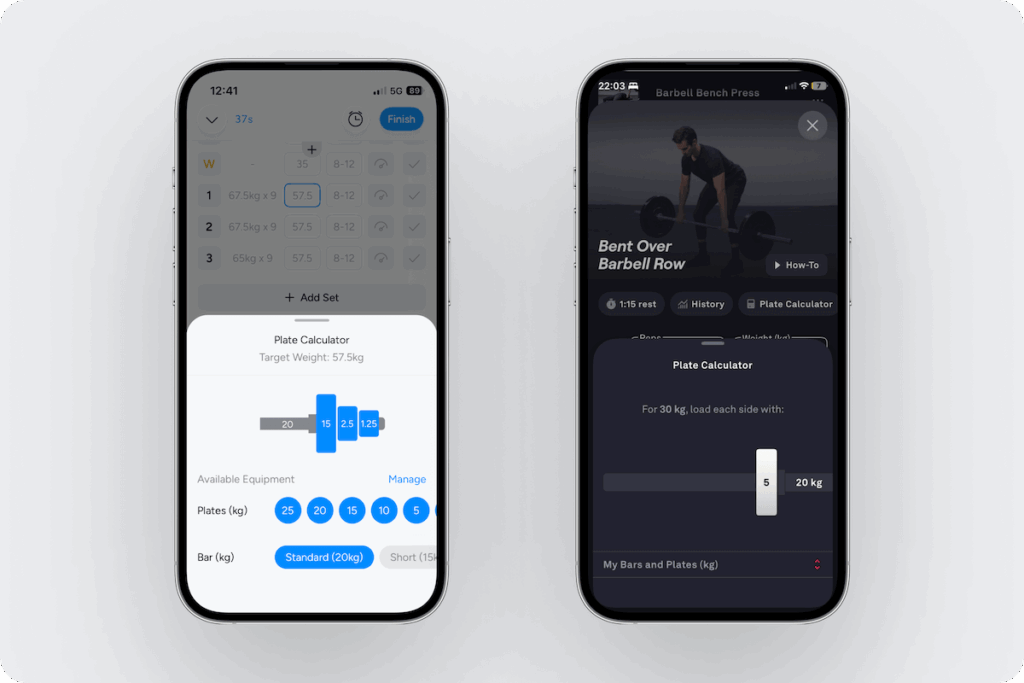
| Plate and bar weight calculator | Yes (free version) | Yes | Tie |
| RPE or RIR entry2 | Yes (RPE per set, free version) | Yes (RIR, after final set of an exercise) | Hevy2 |
| Supersets and circuits | Yes (free version) | Yes | Tie |
| Create and customize routines3 | Yes; includes exercises, sets, weight, rep targets, rest timers, and notes (up to 4 on free tier) | Yes, build manually or generate; if manual, add exercises, sets, reps, weight, and rest timers | Tie3 |
| Exercise library4 | 450+ exercises with demo animations, how-to instructions, and primary/secondary target muscles | 1,600+ exercises with demo videos, how-to instructions, and primary/secondary target muscles | Fitbod4 |
| Custom exercise creation5 | Yes (limited to 7 in the free version; unlimited with Pro) | Yes, unlimited | Tie5 |
| Program library | 26 full training programs in the free tier, plus dedicated routine categories | No traditional program library, generated plans only | Hevy |
| Progression and history6 | Yes (free version) | Yes | It Depends on What You Value6 |
| Onboarding and learning curve7 | Quick onboarding to log your first set within 2 minutes | Longer onboarding with questions to build workout plan | Tie7 |
| Offline reliability8 | Almost entirely functional | Partial functionality | Hevy8 |
Logging speed and UX1 (Winner: Tie)
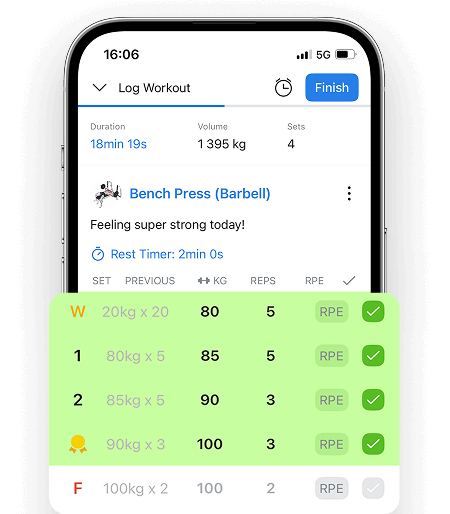
Hevy’s manual logging is built around speed. Every set takes 2 taps, one for weight and one for reps, and the adjustable rest timer starts automatically. Your previous session values are pre-filled on the logging screen, and you can choose between warm-up, normal, failure, and drop set-type toggles. RPE is available as a separate column for each set. The interface is minimalistic and uncluttered, keeping your focus on the next set.
The 2-tap model applies when logging an exercise for the first time; once there’s prior data to pull from, a set can take as little as 1 tap (just the checkmark) or 2 if you need to adjust weight or reps before confirming.
This approach prioritizes control: you can choose your own exercises or follow a program, selecting weights based on prior data. This freedom suits individuals who want a practical tool for overall workout logging.
Fitbod takes a completely different route by removing the option for empty workouts and using generated sessions or ones you’ve built manually. The app pre-calculates your weights and reps from your training history, and you log sets by confirming those values or adjusting them if you need to. It’s important to note that its weight recommendations support improvement over time, but earlier sessions with new exercises often aren’t entirely accurate until the algorithm has enough time to calibrate.
The result of this is less mental load and decision-making, but also less freedom to log things exactly how you want. This approach suits lifters who want to be told exactly what to do during their sessions and prioritize algorithmic generation and adaptation.
This category comes down to how you like to train; if you want to log quickly and freely, Hevy is the better fit, but if you’d rather have a session laid out for you and just confirm as you go, opt for Fitbod.
RPE or RIR entry2 (Winner: Hevy)
Hevy supports RPE entry on every set, and it’s available in the free version. Fitbod only offers RIR after the final set of an exercise.
Because RPE per set is useful for gauging your effort across the entire exercise (and across multiple weights, if you’re using more than one), Hevy wins this category. Fitbod’s RIR entry summarizes the entire exercise as a single number, rather than logging each set individually.
Create and customize routines3 (Winner: Tie)
Hevy’s routine builder starts on the workout page. You can name the routine, then add exercises with weight, sets, and either exact reps or a rep range. Set-type toggles, rest timers, and exercise notes are all available, and you can drag and drop to reorder exercises. On the free tier, you can save up to 4 routines; Hevy Pro removes this limit.
Fitbod also lets you build routines manually as an alternative to generating them. Manual building is straightforward: add exercises, sets, reps, weight, and rest timers, then give it a name. You can save these workouts, but you cannot add them to your pre-generated training split.
Hevy gives you more control and detail to fine-tune the session, and Fitbod offers manual routines as an alternative to algorithmic generation. Each wins here on its own merit.
Exercise library4 (Winner: Fitbod)
Fitbod has a more extensive exercise library than Hevy: 1,600+ exercises compared to Hevy’s 450+. The only downside is that finding the right exercise or variation can sometimes be challenging and may require using filters, such as for equipment, and more keywords.
Custom exercise creation5 (Winner: Tie)
Hevy gives you a fair bit of detail when creating custom exercises: name, equipment, primary and secondary muscle targets, exercise type, and an image, GIF, or video asset. You can also duplicate any existing exercises from the library to create custom variations – handy when using a different brand machine, for example.
Fitbod covers the exercise name, primary and secondary muscles, exercise type, whether it’s a unilateral or bilateral movement, how many weights are needed, and equipment. However, it does not offer a duplication feature.
Both apps let you build custom exercises freely; Fitbod offers unlimited creation, and Hevy’s cap of 7 custom exercises only applies to the free version.
Progression and history6 (Winner: It Depends on What You Value)
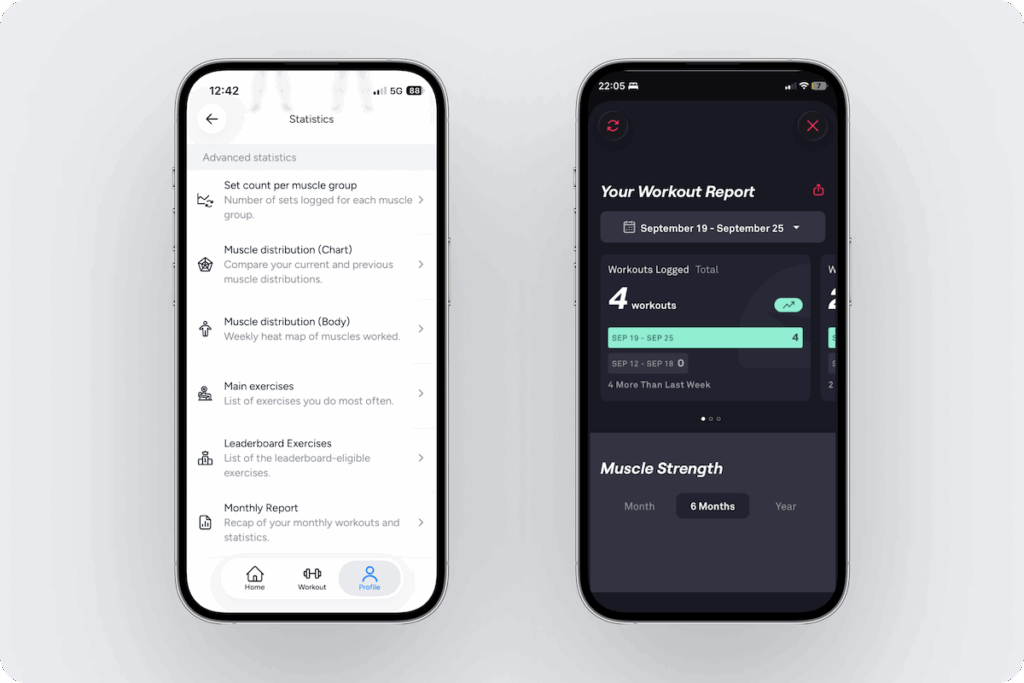
Hevy uses long-range comparison tracking with detailed statistics and per-exercise PRs. Statistics on set count per muscle group, muscle distribution, and main exercises are tracked in graphs or charts for the selected time period, with muscle distribution and performance charts limited to the last 3 months on the free tier and available for all time on Pro.
Exercise leaderboards are available to compare your progress on certain exercises with friends, and per-exercise PRs are listed, including heaviest weight, best 1RM, best set volume, and best session volume for lifts, as well as best pace and furthest distance or total time for other exercise types.
The calendar includes monthly, annual, and multi-year views with a weekly streak counter, and you receive a monthly report covering PRs, muscle distribution, top exercises, and more.
Fitbod offers per-exercise history in two categories: results and trends. Results cover your previous session history with working sets and 1RM; trends show your recent weight lifted, total volume, reps, and 1RM or time, split, and distance on a graph view. The log tab features a monthly calendar, weekly workout goal, and your current streak.
The app provides you with an overall strength score based on your results, as well as muscle-strength data for each muscle group.
There is a workout report in settings that covers the past 7 days, 30 days, or a custom period. This report displays the total workouts logged and overall workout duration. It also displays your muscle strength and per-muscle volume.
Hevy wins in the range of its progression tools, with multi-year calendar views, leaderboards, and all-time graphs and charts on Pro, giving you a longer-term picture of your training. Fitbod’s strength score and per-muscle volume offer more of where you currently stand, so if you’re more interested in short-term progress, it may be worth trying.
Onboarding and learning curve7 (Winner: Tie)
Hevy gets you logging within your first set in minutes, with quick setup and an intuitive interface to explore.
Fitbod spends more time up front asking questions about your goals, experience, and equipment, then builds your workout plan based on your answers.
Offline reliability8 (Winner: Hevy)
Hevy works almost entirely offline. Saved routines, logging, exercise instructions, and previous performance data all function without a connection. You can browse the routine library, but saving a new split to your profile requires an internet connection. Everything syncs automatically when you come back online.
Fitbod also works offline: workout generation, saved routines, and logging still function. However, exercise videos, focus exercises, and your full exercise history or trends require an internet connection, so you will be unable to view your previous sets. Data logged offline will also sync when you reconnect.
Hevy’s offline mode is closer to the full app, so it wins this category.
Intelligence and Program Generation
| Element | Hevy | Fitbod | Winner |
| Smart program generation1 | Yes, Trainer (Hevy Pro) | Yes, primary feature is algorithmically-generated workouts | It Depends on What You Value1 |
| AI features2 | No native AI features, option for AI integrations | Algorithmic workout generation, adaptive recovery tracking | Fitbod2 |
Smart program generation1 (Winner: It Depends on What You Value)
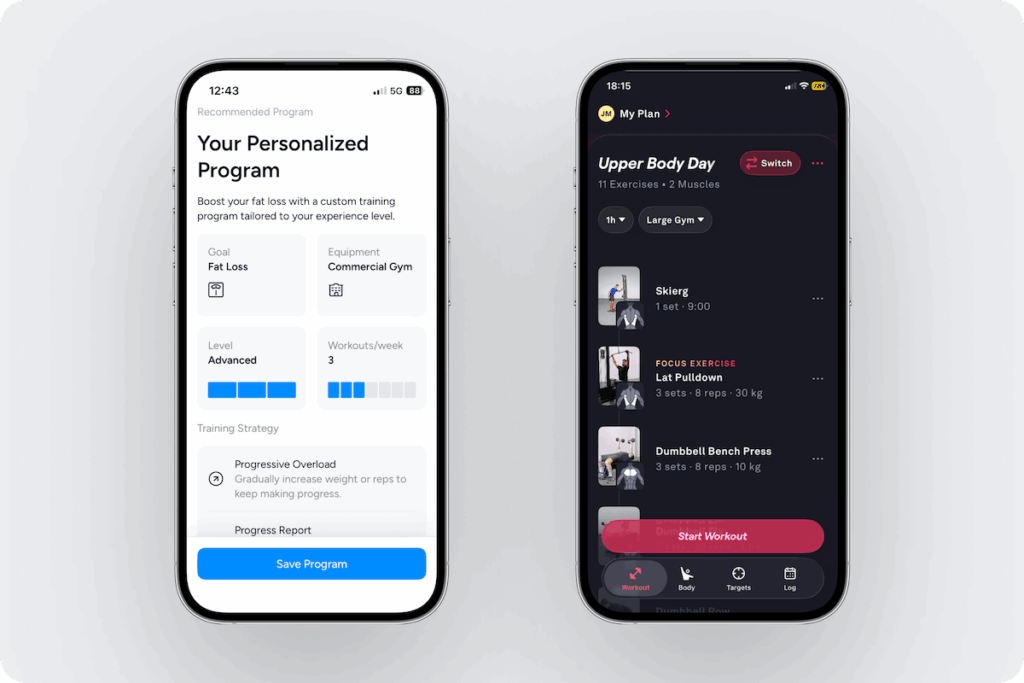
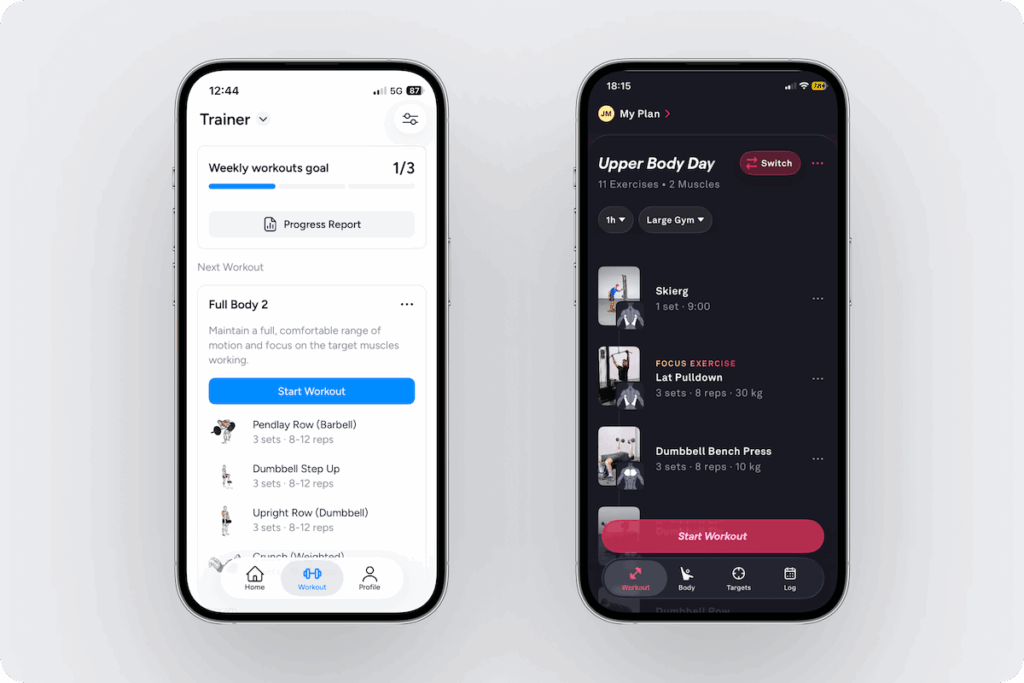
Hevy Trainer asks about your goal, experience, equipment, desired frequency, workout length, and priority muscle group, then builds a complete program with exercises, rep ranges, and rest times. It offers weight suggestions to encourage progressive overload and follows a rule-based algorithm that does not use AI generation.
Trainer also includes injury management, training blocks, and customizability in workout variety, cardio programming, and preferred split type; all accessible in Trainer’s settings. You can view your weekly workouts before you start and track which week of the training cycle you are in. Trainer’s progress report shows consistency, workout duration, total volume, sets completed, volume per muscle group, and bodyweight trends. You can make temporary or permanent changes to your program; swapping an exercise triggers a prompt to replace the exercise in future, keeping the program intact while allowing flexibility.
Fitbod builds sessions from your goal, experience, equipment, and training split, and also factors in muscle recovery, adjusting workouts to target fresh muscle groups. It also has focus exercises that are added into sessions regularly over a four-week cycle, and options for cardio and a variety of stretching exercises before or after your main workout.
It generates one session at a time; each workout refreshes based on your training history, recovery status, or changes in the settings. Its muscle strength algorithm varies intensity and volume between sessions to prevent plateaus.
Fitbod calculates an Estimated Strength for each exercise based on your logged sets, reps, and weight over time, and schedules Max Effort Days automatically to recalibrate this estimate. Max Effort Days cannot be triggered manually or used alongside focus exercises.
So, the winner in this category comes down to how you want your training structured. Hevy Trainer gives you a complete, previewable, and customizable program with periodization, so you know what’s coming and can adjust it.
Fitbod never shows you more than the current session, recalculating in real time based on recovery and performance, so you don’t need to plan or review anything; just open the app and train.
Trainer suits lifters who want to see and understand their program; Fitbod suits lifters who’d rather not think about structure at all.
AI features2 (Winner: Fitbod)
Fitbod’s marketing leans heavily on the term ‘AI trainer.’ The app runs an algorithm that draws on your onboarding or training history, muscle recovery, equipment access, and goals to select exercises and prescribe weight and reps. It is not a language model nor a chatbot-style coach.
This system is native to the app; you do not need a separate integration to use it. It adjusts based on what you’ve logged, with no manual setup.
Hevy has no native AI features, but it integrates with ChatGPT and Claude through official plugins. You can tag @hevy in any ChatGPT conversation to generate training plans based on your preferences, analyze recent workouts, and ask questions about your training progression. Results can be saved directly to your Hevy account, and the integration is free, though importing plans with more than 4 routines requires Hevy Pro.
Fitbod provides an adaptive system with nothing to configure and therefore wins because its AI features are native to the app. Hevy’s ChatGPT and Claude plugins are external integrations, though they are free and give you access to the latest model capabilities.
Social and Motivation
| Element | Hevy | Fitbod | Winner |
| Social feed and community1 | Built-in social feed and discover page (can be disabled in settings) | No social feed, limited gym-specific Clubs | Hevy1 |
| Challenges and streaks | Weekly streak counter, exercise leaderboards with friends | Weekly streak counter, Clubs leaderboards | Hevy |
| Personal trainer integrations | Hevy Coach | Ask a Trainer | Hevy |
Social feed and community1 (Winner: Hevy)
Hevy is built as a social logging app. You can follow other lifters, build a following, and see others’ completed sessions in a content feed that includes photos and videos. You can like, comment, and reply to comments, and save other users’ workouts to try yourself. Social features can also be disabled in settings if you’d rather stay private.
Fitbod has no equivalent to the social system: no feed or following, and no way to see other users’ workouts. It does have a Clubs feature, which lets you join a weekly leaderboard with other Fitbod members at your gym. This is currently regional and limited to new account setup only, so existing users cannot access it.
Hevy wins because its social features are fully built out, optional, and available to everyone.
Trust signals
| Element | Hevy | Fitbod | Winner |
| Ratings and reviews | 4.9 on the App Store (390k+ ratings) 4.9 on the Play Store (285k+ ratings) | 4.8 on the App Store (370k+ ratings) 4.4 on the Play Store (30k+ ratings) | Hevy |
| Company maturity and updates | Very active development, weekly releases | Active development, regular updates | Hevy |
Verdict
Across the 23 categories we compared, Hevy wins 12, Fitbod wins 2, 7 are tied, and 2 come down to what you value. Hevy’s wins cover price, access, and day-to-day logging. It has a free tier you can use indefinitely, Pro for a fraction of Fitbod’s price (with a lifetime option), per-set RPE, a free library of 26 splits, near-complete offline use, data import and export, a web app, a social feed, and leaderboards.
Fitbod wins on its larger exercise library and its built-in adaptive workout generation. Program generation and progression tracking depend on whether you want a full program you can see and adjust, or one session recalculated each time you train.
| Choose Hevy if you want… | Fast, flexible logging A full Trainer program you can preview, adjust, and fit around injuries A free tier to start with Training that works almost entirely offline Motivation from the social feed, exercise leaderboards, and monthly reports |
| Choose Fitbod if you want… | No planning at all: each session is generated for you and recalculated from your recovery and training history Weights and reps set for you A larger exercise library, at a higher price with no free tier |
Other comparisons: