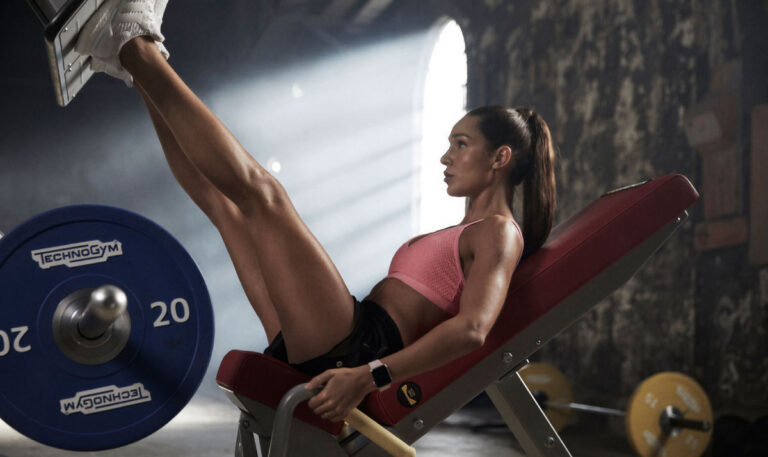
Building strong legs doesn’t have to leave you walking funny for a week. For the most part, the best leg exercises for beginners are the ones that are easy to learn, effective, and simple to progress. My go-to list is the bodyweight squat, glute bridge, reverse lunge, Romanian deadlift, step-up, leg press, leg curl, and calf raise. Start out with your body weight or light loads, aim for twice a week, and focus on nailing down your form before loading up heavy weights.
Key Takeaways
- Train legs 2 times per week. The ACSM’s 2026 position stand found that hitting each major muscle group at least twice a week matters more than the specifics of your program (1).
- Stick to 3 or 4 exercises per session. A squat pattern, a hip hinge, a single-leg movement, and calves cover everything a beginner needs. A 5th or 6th exercise typically adds fatigue.
- Add reps before you add weight. Work in the 8–12 (for compound movements) and 12-15 (for isolation exercises) rep ranges and only increase the load once you hit 12 or 15 reps on every set for 2 sessions in a row.
- You don’t need a gym to get started. Bodyweight and band training produce measurable strength gains, so a step and 1 or 2 dumbbells can carry you through your first month at home (1).
- Follow a plan and track every session. Hevy Trainer (a Pro feature) builds a plan around your goal, experience, schedule, and equipment, and tells you when to add weight.

Top Leg Exercises For Beginners
The best beginner leg exercises are the ones you can load progressively without your form falling apart. The first 5 work at home with bodyweight, a step, or a pair of dumbbells. The last 3 are machines, which take balance out of the equation and let you work your legs harder while you’re still learning to squat and hinge.
Here’s my take: you can start with machines, free weights, or a mix of both. As you’ll read a bit later on, machines tend to be an easier entry point for beginners. The fixed path adds stability, so you don’t have to worry about balance, movement patterns, or coordination while you learn.
Free weights ask more of your stabilizing muscles, but light dumbbell movements like the goblet squat and Romanian deadlift are beginner-friendly from day 1. At the end of the day, pick whichever you have access to and feel comfortable with, then build from there.
1. Bodyweight squat (then goblet squat)
The squat is the meat-and-potatoes leg exercise. It hits your quads and glutes at once, and most other lower-body lifts build on it.
Muscles trained: quadriceps and glutes
Equipment: none; a dumbbell or kettlebell for the goblet squat
- Stand with your feet about shoulder-width apart, toes turned out 15–30 degrees.
- Sit your hips back and down until your thighs are about parallel to the floor, or as low as you can go with a neutral back.
- Drive through your whole foot to stand up.
Form tip: Keep your heels down. If they lift, your weight has shifted to your toes, and your knees are taking load your hips should handle. Once you can knock out 12 clean reps, hold a dumbbell at your chest. The weight in front helps you stay upright, which is why the goblet squat is the best first loaded squat for most beginners.
2. Glute bridge
In my book, the glute bridge is one of the most useful beginner moves since it trains your glutes without loading your spine or knees and gives you a reliable fallback when squats feel off.
Muscles trained: glutes and hamstrings
Equipment: none (full guide: how to do a glute bridge)
- Lie on your back with your knees bent and your feet flat and hip-width apart.
- Squeeze your glutes and lift your hips until your body forms a straight line from shoulders to knees.
- Pause for 1 second at the top, then lower slowly.
Form tip: Higher isn’t better here. Stop when your hips line up with your knees and shoulders; anything past that turns it into a lower-back exercise.
3. Reverse lunge
My beginner routines will always include some form of single-leg work. These exercises are particularly effective for people starting out because they help you notice strength differences between your legs more effectively than two-leg variants.
Muscles trained: quadriceps and glutes, 1 leg at a time
Equipment: none; dumbbells once bodyweight feels easy
- Stand tall with your feet hip-width apart.
- Step 1 foot back about 2–3 feet and lower until both knees reach roughly 90 degrees, back knee just above the floor.
- Push through your front foot to return to standing, then switch legs.
Form tip: Most people find stepping back easier on the knees than stepping forward, because the front leg doesn’t have to brake your momentum. Your front knee drifting slightly past your toes is fine; losing your balance or lifting your front heel is not. If you wobble, widen your stance so your feet are on train tracks, not a tightrope.
4. Dumbbell Romanian deadlift
If I could teach you only one exercise for the back of the legs, this would be it. The Romanian deadlift builds the classic hip hinge pattern, which powers everything from heavy deadlifts to picking up everyday items off the floor.
Muscles trained: hamstrings, glutes, and lower back
Equipment: a pair of dumbbells
- Hold a dumbbell in each hand in front of your thighs, knees slightly bent.
- Push your hips back and slide the dumbbells down your legs, keeping your back flat, until you feel a stretch in your hamstrings.
- Drive your hips forward to stand up.
Form tip: Push your hips back as if you were closing a car door behind you. The stretch in your hamstrings, not the floor, decides how low you go. For most beginners, that’s around mid-shin. If your lower back starts to round, you’ve gone too far.
Related article: The Top Dumbbell Leg Workouts to Attain Powerful Legs
5. Step-up
Step-ups are always welcome in my routines. What can I say? They build single-leg strength with fewer balance demands than lunges, and adjusting the box height gives you a simple way to track progress.
Muscles trained: quadriceps and glutes
Equipment: a sturdy box, bench, or stair
- Stand facing a box, bench, or stair at knee height or lower.
- Place your whole foot on top and push through it to stand up on the box.
- Step down with control and repeat on the other leg.
Form tip: Let the leg on the box do the work. If you’re bouncing off your back foot, the box is too high. Start at 12–18 inches, and once you can do 3 sets of 12 per leg, hold a dumbbell in each hand.
6. Leg press
If I had to pick one machine for a beginner leg day, it would be the leg press because it lets you load your quads while the machine handles balance and back position for you.
Muscles trained: quadriceps and glutes
Equipment: leg press machine
- Sit with your back flat against the pad and your feet hip-width apart in the middle of the platform.
- Release the safety handles and lower the platform until your knees reach about 90 degrees.
- Press back up, stopping just short of locking your knees.
Form tip: Lower the platform only as far as your lower back stays flat on the pad. If your hips curl off the seat at the bottom, your lower back is taking the load. Placing your feet higher on the platform shifts work toward your glutes and hamstrings; placing them lower targets your quads.
7. Leg curl (seated or lying)
The leg curl trains your hamstrings through knee flexion, a function the Romanian deadlift doesn’t cover.
Muscles trained: hamstrings
Equipment: seated or lying leg curl machine
- Adjust the machine so the pad sits just above your heels.
- Curl your heels toward your glutes.
- Take 2–3 seconds to return to the start.
Form tip: If the weight stack slams between reps, it’s too heavy. If your gym has both versions, pick the seated one. In a 12-week study, the seated curl produced more hamstring growth than the lying curl (about 14% vs. 9%), likely because it trains the muscle at longer lengths (2). The study only had 20 untrained participants, so treat it as a tiebreaker, not a reason to skip the lying curl if that’s what your gym has.
8. Standing calf raise
Calves respond best to a full range of motion, so the step matters more than the load at first.
Muscles trained: calves
Equipment: a step or stair
- Stand with the balls of your feet on a step, heels hanging off.
- Rise as high as you can onto your toes.
- Lower your heels below the step for a full stretch.
Form tip: Pause for 1 second at the top and 1 second at the bottom. Bouncing out of the stretch lets your Achilles tendon do the work your calves should be doing. Once 20 controlled reps feel easy, switch to 1 leg at a time.
Related article: Home & Gym Leg Workouts (+ The 25 Best Exercises)
How Many Sets, Reps, And Days A Week?
Start with 2–3 sets of 8–12 reps per exercise, 2 times per week, and end each set with 2–3 reps left in the tank.
| Variable | Starting point |
| Frequency | 2 sessions per week, at least 48 hours apart |
| Sets | 2–3 per exercise |
| Reps | 8–12 (15–20 for calf raises) |
| Effort | RPE 7–8: you could do 2–3 more clean reps (guide to the RPE scale) |
| Rest | 1.5–3 minutes between sets of squats, deadlifts, and leg press; 60–90 seconds for curls and calf raises |
So, how do you progress? Add reps first, then add weight. Let’s say you leg pressed 180 lbs for 3 sets of 10 last week. This week, 180 lbs for 3 sets of 11 absolutely counts as progress. Sure, it doesn’t look like much on paper. But stack a few of those weeks together, and you’ll be surprised how fast the numbers move.
Side note: If you also run or play a sport, schedule it on non-leg days. If you can’t, lift first. A hard run before leg day leaves you with tired legs and sloppy reps, while a run after lifting mostly just feels slower.
How To Warm Up And Cool Down
Lastly, we can’t leave these two out, even if you’ve skipped them more times than you’d like to admit because they didn’t seem all that important.
So, a good leg day warm-up takes 5–10 minutes and ends with a few lighter sets of your first exercise. Start with 5 minutes of easy cardio, like the bike or an incline walk, to raise your heart rate. Then do 1 round of dynamic moves: 10 leg swings per side, 10 bodyweight squats, and 5 reverse lunges per leg.
Then, before your first working set, do 2–3 warm-up sets that build toward your working weight:
| Warm-up set | Load | Reps |
| 1 | Empty bar or light dumbbells | 15–20 |
| 2 | About 50% of your working weight | 5–6 |
| 3 | About 75% of your working weight | 2-3 |
Rest 45–60 seconds between them and keep every set easy, so you’re not tired before the work that counts. Hevy’s warm-up set calculator adds these sets to your routine automatically, rounded to the plates and dumbbells you have.
Cool down with 5 minutes of easy walking, then hold 20–30 second stretches for your quads, hamstrings, and glutes. Use that time to bring your heart rate down and work on the mobility you need for deeper squats and hinges.
A 4-Week Beginner Leg Plan
Having a plan matters, but you need to stick with it long enough to see real results. Run each session 2 times per week with at least 1 rest day in between, and stick to either the home or the gym version for all 4 weeks. Each week adds an exercise or more volume, so you always know what changes next.
From week 3, the glute bridge moves into your warm-up (2 × 15), and the home version needs 1 or 2 dumbbells (or a kettlebell). Looking for a tailored program? Hevy Trainer can build custom beginner plans that account for your available equipment, primary goal, preferred workout duration, and even existing injuries.
| Week | Home version | Gym version | Sets | Reps | Rest |
| 1 | Bodyweight squat | Leg press | 2 (plus 2 warm-up sets) | 8–12 | 1.5–3 min |
| Glute bridge | Glute bridge | 2 (plus 1 warm-up set) | 12–15 | 60–90 sec | |
| Calf raise | Calf raise | 2 | 12–15 | 60–90 sec | |
| 2 | Bodyweight squat | Leg press | 2 (plus 2 warm-up sets) | 8–12 | 1.5–3 min |
| Glute bridge | Glute bridge | 2 (plus 1 warm-up set) | 12–15 | 60–90 sec | |
| Reverse lunge | Leg curl | 2 | 8–12 (Home) / 12–15 (Gym) | 1.5–3 min (Home) / 60–90 sec (Gym) | |
| Calf raise | Calf raise | 2 | 12–15 | 60–90 sec | |
| 3 | Goblet squat | Leg press | 3 (plus 2 warm-up sets) | 8–12 | 1.5–3 min |
| Romanian deadlift | Goblet squat | 3 (plus 1 warm-up set) | 8–12 | 1.5–3 min | |
| Reverse lunge | Romanian deadlift | 3 | 8–12 | 1.5–3 min | |
| Calf raise | Leg curl | 3 | 12–15 | 60–90 sec | |
| 4 | Goblet squat | Leg press | 3 (plus 2 warm-up sets) | 8–12 | 1.5–3 min |
| Romanian deadlift | Goblet squat | 3 (plus 1 warm-up set) | 8–12 | 1.5–3 min | |
| Reverse lunge (Swap: Step-up session 2) | Romanian deadlift | 3 | 8–12 | 1.5–3 min | |
| Calf raise | Leg curl | 3 | 12–15 | 60–90 sec |
Knee-Friendly And Seated Leg Exercises
Sorry to break it to you, but knee issues don’t mean you can’t train legs. You can always find comfortable variations and ranges of motion to continue building strength to combat those pains. Hevy Trainer can automatically account for existing injuries and adjust your workout plan accordingly, though severe or persistent joint pain requires a medical professional’s evaluation.
A little muscle burn or fatigue is nothing to worry about, but sharp joint pain is a different story. Adjust the movement or get advice from a professional.
Plenty of people skip exercises like squats because they fear for their knees. But if you have healthy joints, the risk comes from loading at a depth you can’t yet control. And just to be clear, most knee complaints I hear from new lifters come from using poor form or lifting heavier than they’re ready for, not from squatting itself.
That said, switching to reverse lunges and goblet squats for a while, or squatting a bit less deeply with a slightly wider stance, can help reduce strain while allowing you to train comfortably. That’s the whole logic behind the swaps below. They shorten or simplify the movement to help accommodate your current limits.
Lunge and squat alternatives for knee pain
| If this hurts | Try this instead | Why it helps |
| Bodyweight squat | Sit-to-stand from a chair | The chair sets your depth for you |
| Reverse lunge | Step-up on a low step (6–8 inches) | Less knee bend under load |
| Leg press | Leg press with a shorter range | Stop above the angle that hurts |
| Any squat or lunge | Glute bridge | Trains your glutes with almost no load on the knees |
Seated leg exercises
We can’t forget about chair exercises as a starting point if you’re returning after a long break or can’t stand for long periods. Use a stable chair without wheels or armrests, where you can sit with your feet flat and your knees at 90 degrees (3).
- Seated march. Sit upright without leaning back, lift 1 knee as high as is comfortable, lower it, and switch legs. Start with 5 lifts per leg.
- Seated knee extension. Straighten 1 leg in front of you, hold it for 5 seconds, and bend it slowly. Repeat with the other leg.
- Seated heel and toe raises. With both feet on the floor, lift your heels as high as you can, lower them, then lift the front of your feet.
- Seated glute squeeze. Squeeze your glutes, hold for 5 seconds, and relax.
- Sit-to-stand. Sit on the edge of the chair with your feet hip-width apart, stand up, then sit back down slowly. This is the bridge between seated work and the bodyweight squat.
Do them at least 2 times per week and add reps gradually. Once you can do 12 sit-to-stands without using your hands, start week 1 of the plan above. If you haven’t been active for a while, check with your doctor first.
How To Progress Without Getting Hurt
The secret to keeping injuries out of your training is to prioritize technique over weight. Most beginner injuries don’t come from a single bad lift. They come from weeks of reps that slowly get shorter, faster, and sloppier while the weight keeps going up.
When I started lifting, I was convinced squats were bad for my knees. Every session ended with a dull ache, and I just ignored it. Then a coach saw me doing one and stopped me mid-set. The thing is that my heels were coming up on every rep. How did we fix it? I cut the depth to a box, slowed the lowering to 3 seconds, and kept the weight light. Over time, the discomfort gradually diminished, and I was able to progress into a full squat.
One handy piece of advice might be to film your sets. Fair warning, it will be humbling. Like a set of Bulgarian split squats that felt rock-solid but looked awful on video, with the last few reps getting shallower and wobblier. But it happens to pretty much everyone (even pros), and these videos help you see what you might’ve missed, take a little weight off, and rebuild.
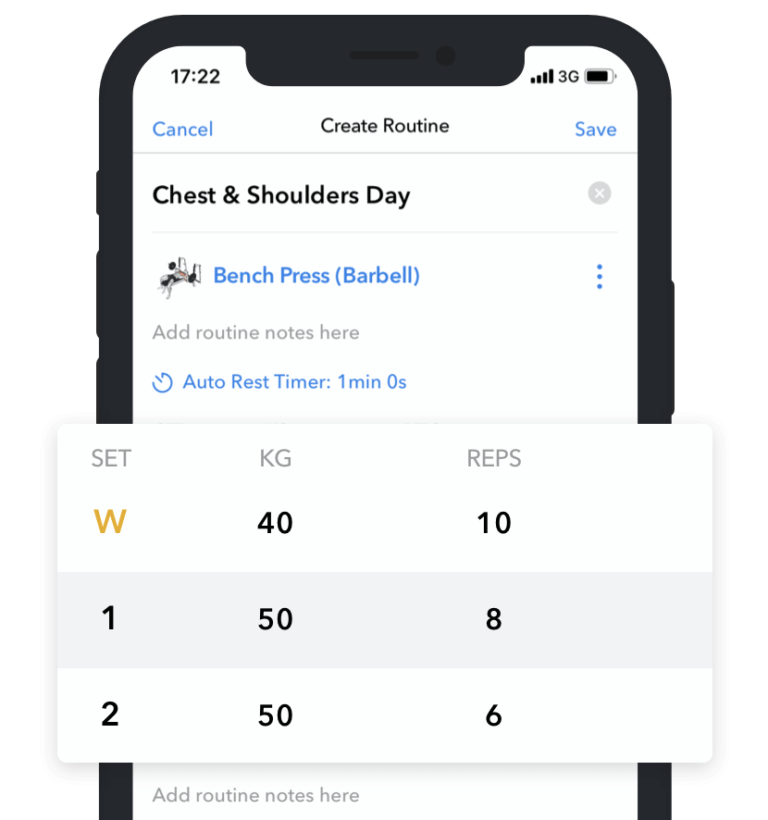
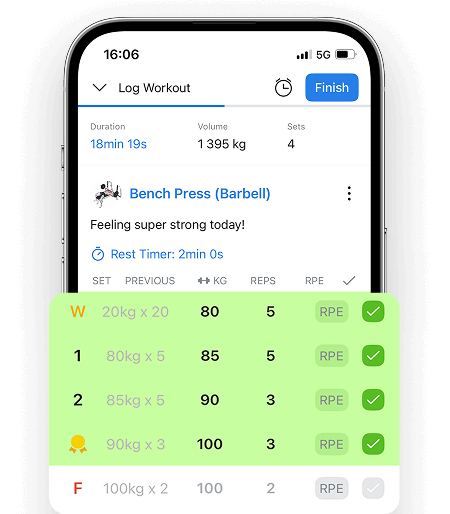
My suggestion? Log every set in the Hevy app and work from there. The auto-rest timer ensures your rest is consistent, by comparing your numbers from week to week. And that’s really the only reliable way to tell whether you’re actually getting stronger. Trust me, your memory makes a terrible training log.
Conclusion
Strong legs don’t come from one brutal leg day. They come from showing up consistently. Pick 3 or 4 basic exercises, train them twice a week, and follow the 4-week plan, adding reps before load.
Hevy’s free routine library has 26 complete programs for every experience level (a great starting point if you’re feeling somewhat confused), and Hevy Trainer, our programming algorithm, builds a custom plan for you with progressive overload built in. Logging is quick, and every exercise comes with step-by-step instructions and demo animations, so you can check your form between sets instead of guessing.
FAQ
How can beginners build leg strength at home?
Bodyweight movements and band training are great for strength gains you will notice in the short term, according to the ACSM’s 2026 position stand. Start with squats, reverse lunges, glute bridges, and step-ups. Once these seem easy, make them harder by adding reps, slowing the lowering phase to a 3-second count, or holding a dumbbell. Once you can hit 15 clean reps, it’s time to move on to a harder variation, like replacing the bodyweight squat with a goblet squat.
What is a good leg day routine for beginners?
Keep it simple with about 4 exercises (like a squat, a hip hinge, a single-leg movement, and calf raises) for 2–3 sets of 8–12 reps, 2 times per week. Warm up for 5 minutes first, and add reps before you add weight.
Should beginners train legs on their own day?
Not necessarily. An upper/lower split should include dedicated leg training on ‘lower’ days (typically twice per week), while full-body routines distribute leg work across sessions, sometimes hitting legs every workout if focusing on just one exercise per session. Both approaches suit beginners well without needing a bro split. A single dedicated leg day per week makes more sense once you’re training 5 or more days weekly. See our upper/lower split guide for detailed programming.
What is the #1 leg exercise for beginners?
The bodyweight squat is the #1 leg exercise for beginners. It trains your quads and glutes together, needs no equipment, and progresses directly to the goblet squat and the barbell back squat. Train until you feel like you could only do 2-3 more reps with good form and the same range of motion. And don’t feel pressure to get to a certain number; it could be anywhere from 5-6 to 20+ reps; do what feels challenging to you.
What are the 3 best leg exercises?
The 3 best leg exercises are a squat, a Romanian deadlift, and a single-leg exercise like the step-up. Together, they cover all the big bases: knee-dominant, hip-dominant, and single-leg training.