Getting older doesn’t mean you have to train less. Nor is it something you should fear. It means you have an opportunity to train smarter, recover better, and pay attention to things you may have once ignored.
This guide is for everyone over 40 who wants to continue (or start) working out in an intelligent, sustainable way that supports fitness and longevity.
Key Takeaways
- Aging doesn’t mean you have to stop lifting heavy, but you should adjust your training to account for changes in recovery, mobility, work capacity, and injury history.
- Warm up properly, use full ranges of motion, and consider variations or machines that allow you to train hard without unnecessarily aggravating your joints.
- Strength is only one component of overall fitness. Include cardio, mobility, balance, power, muscular endurance, and other forms of training to maintain well-rounded fitness as you age.
- Learn to train intuitively by adjusting your strength training exercises, intensity, and volume based on how you’re recovering and how your body feels on a given day.
- Consistency matters more than following a rigid strength training program. Your training will inevitably change as you age, and learning to adapt is what allows you to keep progressing for decades.
Let’s get the elephant out of the room.
I’m 39 years old.
As a 19th-year strength coach, however, I’m no stranger to my demographic. In fact, a solid 80% of my clientele over those years have been 40+. At 22 years old, I can guarantee my approach to working with clients reflected my calendar age.
Not having plenty of mileage on my body, no major injuries, and all the energy in the world with minimal responsibilities created the perfect storm for me to train hard using the trite ‘no excuses’ approach and face no repercussions. It also led me to set unrealistic expectations for the older clients I worked with.
That’s because as life goes on, maturing as a lifter means realizing that trying to train like the above is unsustainable.
There’s also a biological reason. Without activity (particularly resistance training), muscle loss begins as early as a person’s mid-thirties (1). If I were to start working with someone in their forties who is new to training, I would be mindful of that and allow them to progress at their own pace. This is something to look for in any coach or personal trainer, if you decide to hire one.
The Programming Dilemma – We’ve Dropped the Ball
Check out most “good” programs in textbooks or online, and despite sound methodologies, workouts, and coaching cues, a critical eye will realize that the world of strength and conditioning has missed the mark.
The reason why: They assume a “clean slate” for every lifter who tries it. They can’t account for lifters who, as part of their life ‘mileage’, have to deal with:
- Chronic joint pain
- Poor sleep or recovery
- Prior surgeries
- An acute injury history
- Stressful work schedules
- Limited training availability
Any or all of the above are unfortunate realities of training in the real world, and they deserve to be addressed – especially since the over-40 crowd typically deals with these realities more than anyone else.
One can say “smart” programming should get ahead of things so that it never becomes a factor – but that’s asking too much of real life. Most people are already in the soup and need to play the long game despite limitations.
Having a comprehensive guide to know just what to do, and how to properly play the game of damage control, is important, so putting them all in one place can be the game-changer you need to set you up for the rest of your life.
Checkpoint #1: Never Skip a Warm-Up
There is literally no excuse for this; a properly conducted warm-up can be a definite make-or-break factor in the quality of your workout and one of the best injury-prevention tactics (2).
Many young lifters may be resilient and durable enough to get straight to heavy lifting without a warm-up at all, or by rushing through something imprecise, like a brief jog on the treadmill, without any immediate repercussions.
Add 20 years to the equation, and there’s no escaping the importance of getting your muscles and connective tissue prepared to resistance train. For reference, a proper warm-up should do 5 key things:
- Increase heart rate
- Elevate body/muscle temperature (you may begin to sweat)
- Release synovial fluid to joints
- Create specific movement prep
- Activate the central nervous system
With that said, if you were planning to do a barbell squat-focused workout, your warm-up may look something like this:
- Spiderman walks – 2 sets of 10 meters
- High knee hugs – 2 sets of 10 meters
- Hip Rockbacks – 1 set of 15 rockbacks
- Deep squat hold or 4-point squat (bodyweight) – 5 reps
- Empty bar jump squats – 1-2 sets of 4-6 reps
All of the above sounds lengthy, but the truth is, it shouldn’t take longer than 6 or 7 minutes to get through. And it accomplishes all 5 of the goals mentioned above.
Checkpoint #2: Make Lighter Weight Feel Heavy
Lifting as much weight as possible in every single workout is not only something very juvenile and ego-driven in its intention, it’s also something that isn’t sustainable if you’re in this for the long haul.
Respecting your mileage means giving your body the chance to salvage the joints from the same amount of absolute loading, session after session. So take advantage of some framing changes in your workout construction.
If you can bench press 225 for your 3-rep max using normal, conventional reps, the obvious form of progressive overload is to do more reps or eventually try to lift more weight, right? Not necessarily. Here’s an alternative:
Start adding strict 3-second eccentrics and a full pause on the chest. I’ll guarantee you won’t be able to move 225 for 3 reps anymore. Make whatever you have to reduce the weight to instead become your new 3-rep max. Your joints will thank you. As a bonus, you’ll increase the chance of using proper form, and you may build muscle mass due to the added time spent under tension (3).
One more idea: use different resistance profiles. If your gym has implements to dress your barbells with, like chains or bands, this can be a way to increase resistance at the top of movements and reduce it at the bottom, where joints are usually in the most compromised and vulnerable position.
There’s a big difference between a 405-pound squat bar made up of 4 plates, versus a 405-pound squat bar made up of 2 plates (225), and 180lbs worth of chain weight.
Checkpoint #3: Prioritize Bodybuilding and Strongman Style Training Methods
One thing I’ve made sure to do with my clients and have been even implementing myself much more than before is spending less time doing the standard powerlifting compound staples. Let me explain.
There’s nothing inherently wrong with the squat, deadlift, bench press, or strict press patterns. But the thing to realize: They’re probably the most unforgiving and the least compromising movements in all of training.
The trade-off in frequenting these lifts is that they do invite joint stress, not only due to the nature and biomechanics of the movement (especially pertinent to a person’s individual anthropometry and leverages), but also due to the amount a person can typically load these kinds of lifts. Building the skills in these movements often comes with a mild trade-off, especially when done over many years.
When middle age hits, it’s smart to start using machines more for muscular isolation to spare cranky joints. Subbing out a back squat for a hip belt squat every other leg day is a good example of this. Doing overhead presses on a Smith machine and opting for a seated chest press instead of a barbell bench press are two more.
As far as strongman training is concerned, no one’s telling you to start towing airplanes or tossing kegs over 20-foot bars, unless you want to.
My point here: Traditional strongman training usually involves one thing that a lot of conventional strength training leaves out: locomotion (moving from one spot to another). Loaded carries of all forms (like farmer’s walks and fireman carries) can work wonders for conditioning, posture, and grip strength, and offer great benefits for “real world” strength with direct application to legitimate life tasks.
I’ll always believe in the big picture: a 300-pound farmer’s walk for 30 seconds is more useful than a 300-pound deadlift for 5 reps. Other unconventional methods like lifting stones or sandbags, and doing Zercher holds, squats, and lunges are worth their weight in gold for any physical labor you may be tasked with on the outside.
Checkpoint #4: Train Through Full Range of Motion
As mentioned in point 1, it’s important to respect mobility. That being said, loading your joints through only partial ranges of motion doesn’t benefit your body beyond avoiding weak spots, leaving the untouched ranges more susceptible to problems.
I’m a believer in making a muscle strong through the entirety of its corresponding joint’s available range of motion. That will have a positive impact on mobility and promote joint health if done safely and responsibly. It can also lead to better and more balanced muscle growth, particularly in cases where someone has routinely ignored a portion of a given range of motion for years.
Always make training for partial ranges a choice, and not a default. Make it your aim to do half reps because you want to – not because you’re so immobile that you have to.
Checkpoint #5: Stay Active & Never Forsake Cardio
If you’re over 30 – taking care of your heart and lungs should be a significant part of the equation. There’s plenty of research available to show that the heart rate increase you get from tough sets of heavy reps isn’t the same kind of cardio that you get from getting focused on steady state, long endurance for 20, 30, or 45 minutes (4).
Aiming for a weekly grand total of 3 hours of steady state cardio using the modality of your choice:
- Stairmaster,
- Treadmill
- Elliptical
- Rowing machine
Or, if you prefer to go outside to stay active, cool activities include:
- Biking
- Hiking
- Swimming
Checkpoint #6: Learn to Train Intuitively
What does this mean?
It means stop saying married to your program come hell or high water. Your program might be brilliant, but it doesn’t know your body, what’s bugging you today, or the poor night’s sleep you got because of a stressful work week.
This isn’t an excuse to cop out of hard work. It’s a reminder to listen to what your body is telling you. If your low back, which you’ve injured in the past, is sore and twingy upon waking one morning, it may be worth rethinking your programmed deadlift clusters at 95% of your max effort.
Sometimes the juice isn’t worth the squeeze. Switch it up and lift lighter, or find a variation (or substitution) for the day that still promotes hard work without aggravating cranky joints or exacerbating an existing problem. That’s training hard and smart.
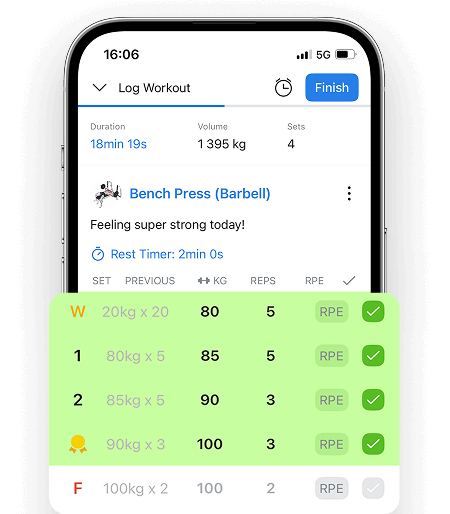
This is one reason why a digital workout logger (like an app) tends to work better. You can store your training plan there and easily make modifications when needed. For instance, in Hevy, you can adjust the weight and reps per set, modify the automatic rest timer, add or remove exercises, and write helpful clarifications in the form of workout and routine notes.
Checkpoint #7: Remember the 11 Components of Fitness
Strength is arguably the most important missing link to determine someone’s overall longevity. But I’d argue that fitness as a whole is irrefutably paramount.
What a lot of people get wrong: Strength is not fitness. It’s only a part of it.
There are 11 components of true health and skill-related fitness:
- Strength
- Speed
- Power
- Muscular endurance
- Cardiorespiratory capacity
- Balance
- Agility
- Co-odrination
- Healthy body composition
- Reaction time
- Flexibility
Being strong can certainly spill over into a couple of the other components, but not nearly all of them. You’re not a kid anymore, and it’s time to start taking all aspects of your fitness seriously. Nothing wrong with pursuing a muscular physique that’s capable of lifting heavy things. But if that’s all you’ve got, you’re hardly ahead of the game.
Diversify your training. Put in the time for a couple of phases of high-rep work, plyometric, athletic, and bodyweight-oriented work, cardio-heavy work, and unstable-surface work throughout your training year. It’ll keep your fitness rounded.
Checkpoint #8: Make Therapy Part of Your Non-Negotiable Routine
This will be the shortest checkpoint.
If you’re not scheduling monthly visits to your registered massage therapist, your fascial stretch therapist, or osteopath, it’s time to change that. Keeping a car built in 1985 in pristine condition to go pedal-to-the-metal on the streets takes more upkeep than doing the same with a car built in 2024.
Even if you feel “fine”, it’s worth investing in yourself for regular tune-ups to ensure your tissue quality and skeleton are in proper working order. Pushing yourself in the weight room every week isn’t something your body should ever take for granted.
Checkpoint #9: Stop Eating Like You’re 21
Similar to the point above, maturing as a lifter means fueling your body in the right ways. If you’ve been someone who’s made it a habit to avoid supplementation, regularly consume processed foods, abuse alcohol consumption, and hydrate yourself using everything but water, you’re shooting yourself in the foot.
Focus on proper nutrition by making it a habit to consume whole foods and stay well-nourished and hydrated for your goals, and your body will thank you with improved performance.
If you want an actionable goal, track your protein. The current consensus is 1.6 to 2.2 grams of protein per kilogram of body weight (or 0.7 to 1 gram per pound) (5).
Checkpoint #10: Adjust Your Resistance Training Volume
Something lifters begin to lose as the years roll by: work capacity. When I was 20 years old and putting on size for the first time, I relied on trisets. For chest, I’d hit flat barbell bench press, then immediately follow up with dumbbell incline presses, and finish off with cable chest flyes. I’d do this for 4 rounds before moving on.
Today, I couldn’t dream of doing this. I’d be on my back midway through round 2.
It’s important to be cognizant of the changes to work capacity and general energy levels that will occur with age. For most people over 40, this means strength training 2-4 times per week, with the former being a completely acceptable workout schedule if that’s what feels manageable.
Additionally, what matters much more than a fixed intensity or volume is your RPE (rate of perceived exertion). If you can maintain the sensation of training at around 8 out of 10 – where 1 feels like no effort whatsoever, and 10 feels like the hardest thing you’ve ever done, then half the time the amount of weight you actually use (or the percentages of your true maxes) don’t matter nearly as much.
If you’re having a down day at the gym or struggling with your recovery, consider reducing your overall workout volume by 25%. That can be as simple as removing one set from every exercise in your workout. Or it could mean lowering the weight and lifting for fewer reps per set.
FAQs
1. How do I ensure proper recovery when training after 40?
Mainly, manage your volume by sticking to 2-4 resistance workouts (along with elements of plyometrics, loaded carries, and balance work), doing dedicated cardio at 60-70% of maximum heart rate, and sleeping well. It’s also recommended to rest a muscle for 24 to 48 hours before training it again.
2. Can strength training help with menopause symptoms?
Yes, according to a recent review, resistance training can develop physical strength, improve bone density, combat hormonal changes, and even reduce hot flashes (6).
3. What is a good strength routine for someone over 40?
A sustainable strength training routine typically includes 2 to 3 full-body sessions each week. In addition to cardio, this is plenty of activity to support fitness.
4. Can I still lift heavy after 40?
Of course. Plenty of 40+ lifters have found great success in strength sports like powerlifting. But it’s important to be mindful of physical limitations and take extra good care of your body through proper warm-ups, the use of warm-up sets, not forgetting other components of fitness, going for regular physiotherapy, eating mostly whole foods, and leaning on intuitive training instead of a rigid plan.
Conclusion
We’ve all seen at least one legitimately old lifter in the gym who is in surprisingly good shape. The next time you do, ask them how they train to maintain their levels of fitness, and their answer will likely shock you. I’ll guarantee their focus shifted from the heavy, no-excuses approach to a more thoughtful, customized, multifaceted approach to training that remembers the little things and is in tune with how they feel.
Whether you’re 20, 40, or 80, what really matters more than anything is to train consistently. The complexion of your training will change over time, and that’s inevitable. Once again, maturing in the gym means being able to roll with the punches and just keep showing up.
Download Hevy to document your training and see how it changes over time. Log each session with the necessary details, track performance, and add context with custom exercise notes. Looking for training guidance? Check out Hevy Trainer (Pro feature, only $2.99/month) and get a customized plan that accounts for your goal, experience, available equipment, and more.