Do you want to build muscle or strength? In the past, the general advice was that you need to choose. Powerlifters prioritize maximal strength while bodybuilders focus on muscle size and physique.
But why not just do both? A new style of lifting does this by combining the best of both approaches: powerbuilding. This guide explains how powerbuilding works, who it’s for, and how to follow an effective program for long-term results.
Key Takeaways
- Powerbuilding combines powerlifting and bodybuilding to improve maximal strength and muscle hypertrophy in a single training program.
- Heavy compound lifts build strength, while higher-volume accessory work provides the training volume needed to maximize muscle growth.
- Most lifters benefit from a 4-day upper/lower split, allowing each muscle group to be trained twice per week while managing fatigue.
- Progressive overload, sufficient weekly volume, and proper recovery are the primary drivers of long-term progress.
- Powerbuilding is ideal for intermediate lifters who want to become both stronger and more muscular without specializing in either competitive powerlifting or bodybuilding.
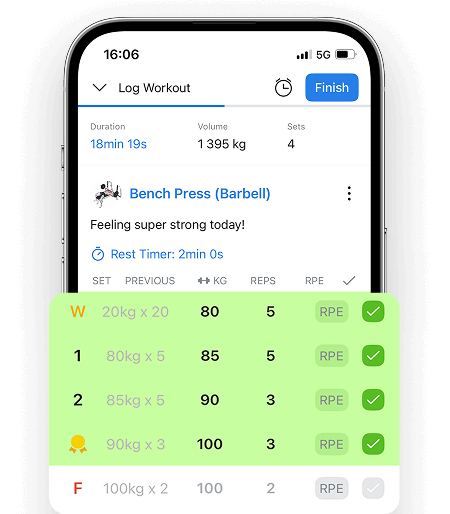
- For best strength outcomes, track each workout closely, so you know if you’re improving. For muscle gain, track body weight, circumference measurements, and progress photos. Hevy allows you to log each workout in detail and track body measurements.
What Is Powerbuilding?
Powerbuilding is a method that combines the strength-focused principles of powerlifting with the muscle-building principles of bodybuilding. Rather than specializing exclusively in one training style, powerbuilding develops both simultaneously.
A typical workout might look like:
Start with heavy compound exercises such as the squat, bench press, or deadlift performed for relatively low repetitions.
Transition into moderate accessory work such as lat pulldowns, dumbbell Romanian deadlifts, and seated shoulder press.
Finish with high-rep isolation exercises that increase weekly training volume and target individual muscle groups.
Powerbuilding vs. Powerlifting
The first part of powerbuilding is powerlifting, a strength sport centered around three lifts:
- Squat
- Bench press
- Deadlift
The objective is to lift the greatest amount of weight possible for one repetition for each lift. Unlike most in the fitness industry, who train to look good, powerlifters prioritize performance. Their programming revolves around improving those three movements.
Accessory exercises are designed to strengthen weak points and improve competition lifts, rather than to maximize muscle size.
Physique also takes a back seat. Rather than looking good on stage, powerlifters generally manage their weight to compete in a specific weight class. For a successful powerlifter, the only thing that matters is producing the most force.
Powerbuilding vs. Bodybuilding
Bodybuilding has an entirely different objective that sits on the other side of the spectrum: building mass and aesthetics. Rather than maximizing strength, bodybuilding focuses on developing muscular size, symmetry, proportion, and conditioning.
Bodybuilding training typically includes:
- Higher training volumes
- More exercise variety
- More use of isolation and smaller exercises
- Moderate repetition ranges
- Training close to muscular failure
While bodybuilders certainly become strong, the amount of weight lifted is secondary to muscle growth.
Powerbuilding vs. Powerlifting vs. Bodybuilding (Table Summary)
| Training Variable | Powerlifting | Powerbuilding | Bodybuilding |
| Primary goal | Maximal strength | Strength + muscle | Muscle hypertrophy |
| Main exercises | Squat, Bench, Deadlift | Compound lifts + accessories | Wide exercise selection |
| Rep range | 1-5 | 3-20 | 6/8-20 |
| Weekly volume | Moderate | Moderate-High | High |
| Intensity | Very high | Mixed | Moderate |
| Progress measured by | Weight lifted | Strength + muscle growth | Physique development |
Why Many Lifters Choose Powerbuilding
For most recreational lifters, neither the extreme of bodybuilding nor that of powerlifting is ideal. Most people want to improve their physique while also building strength. Powerbuilding bridges that gap.
It allows you to progressively improve your lifts while accumulating enough weekly volume to maximize muscle growth across every major muscle group.
What Does Hypertrophy And Strength Training Look Like?
What Drives Muscle Growth?
Muscle growth (hypertrophy) occurs when resistance training delivers a stimulus sufficient enough to trigger adaptation in your muscles. This involves the enlargement of muscle fibers, increasing their cross-section (1).
While many factors contribute, research consistently shows that increasing training volume is the ultimate driver of muscle growth.
Hypertrophy Training Variables
- Weekly training volume – 10-20 hard sets per muscle group (2)
- Load used – moderate load of 60-80% 1RM
- Rep range – moderate range of 8-12 reps
- Intensity – training close to failure (typically 0–3 RIR or RPE 7-10)
- Equipment – dumbbells, machines, cables, barbells, pull-up/dip bar, and more
- Exercises – mix of compound and isolation exercises
What Drives Strength Gains?
Strength gains occur from muscular adaptations and improvements in your nervous system’s ability to produce force efficiently. To maximize strength, training should prioritize heavy loads, movement specificity, and consistent progression over time.
To simplify, think of strength training as teaching your muscles to work together.
Strength Training Variables
- Weekly training volume – 3-10 heavy sets per week
- Load used – heavy loads; ≥80-85% 1RM (3)
- Rep range – low reps (1-5)
- Equipment – mainly barbells
- Exercises – large, compound exercises (deadlift, bench press, bent-over row)
- Rest – sufficient rest between sets (3–5 minutes)
- Exercise specificity – train the lifts you want to improve
What’s The Main Difference Between Strength And Hypertrophy Training?
One big difference between strength training and hypertrophy training is the load used.
Hypertrophy training primarily uses loads of 60-80% 1RM as it allows maximal volume with sufficiently heavy loads. However, new research shows that volume from any load contributes to hypertrophy.
Strength training is vastly different, as it requires heavier loads as you progress. While 80% 1RM works, most research shows that loads of 85% 1RM are needed for optimal adaptations (3).
Read our full guide to understand how training for optimal strength differs from hypertrophy workouts.
Powerbuilding Pros and Cons
Pros
- Builds strength and muscle simultaneously – By combining heavy compound lifts with higher-volume accessory work, powerbuilding develops maximal strength and muscular hypertrophy within the same program.
- Creates a balanced physique – unlike strength-only programs, powerbuilding includes enough accessory work to develop all major muscle groups, improving overall symmetry and aesthetics.
- Enjoyable training variety – alternating between heavy strength work and hypertrophy training keeps workouts engaging while reducing the monotony of performing only the big three lifts.
- Easy to measure progress – you’ll have multiple ways to track improvement, including increases in strength, repetitions, training volume, and muscle size.
- Improves athletic performance – greater strength, muscle mass, and work capacity carry over well to recreational sports and everyday physical activities.
Cons
- Longer training sessions – combining strength work with accessory exercises tends to require more time (not always).
- Greater recovery demands – heavy loads and higher weekly training volume require consistent nutrition, sleep, and fatigue management.
- Slower adaptations – because time and volume are split between hypertrophy and strength training, progress for either is generally a little slower.
To be honest, we’re being as critical as possible with the cons. For most recreational lifters, these trade-offs are well worth it. Also, slower growth isn’t inherently a bad thing, especially if it’s slow growth in both strength and size.
Why Powerbuilding Works
Powerbuilding works because strength and muscle growth are driven by many of the same fundamental training principles. The differences exist in how they’re applied to training. Rather than treating them as separate goals, powerbuilding combines the most effective aspects of powerlifting and bodybuilding into a single program.
- Heavy compound lifts maximize strength
- Higher-volume accessory work stimulates continued muscle growth.
Mechanical Tension And Neural Adaptations
Mechanical tension is the primary driver of hypertrophy. When a muscle senses tension, it triggers a series of events that increase muscle protein synthesis (4).
Mechanical tension → mechanosensors → anabolic signaling → muscle protein synthesis → hypertrophy
On the other hand, strength is driven by neural adaptations. This means your brain “talks” to your muscles more efficiently, allowing them to generate more force. However, the same movement that places mechanical tension on a muscle also triggers these neural adaptations.
Unlike pairing endurance with bodybuilding, you don’t need to use a completely different piece of equipment. The volume of strength training directly contributes to hypertrophy.
Progressive Overload
Your body only adapts when training demands gradually increase, a principle known as progressive overload (5). Some of the most common ways to achieve it are:
- Adding weight
- Performing more repetitions
- Increasing weekly volume
Over time, these small improvements lead to significant gains in both strength and muscle.
Training Volume
Volume from heavy lifting contributes to muscle growth, but it’s generally not enough to maximize hypertrophy. Accumulating sufficient weekly training volume is the primary driver of muscle hypertrophy. General guidelines suggest 10-20 hard sets per muscle group for optimal growth.
However, these numbers assume you’re using a typical bodybuilding scheme. 10-20 sets of heavy triples isn’t going to have the same effect as 10-20 sets of 8-10 reps.
Therefore, accessory exercises provide this additional volume, allowing you to develop muscle without compromising your primary strength work.
Specificity
Strength is highly specific to the movements and loads you train. Simply put, if you want a bigger squat, you need to squat heavy.
A program that primarily consists of performing hack squats and leg presses with 10-15 reps won’t develop the technical skill and neural adaptations required to maximize barbell performance.
Powerbuilding addresses this by prioritizing heavy compound lifts early in the workout, then using accessory exercises to increase overall muscle development.
Heavy Strength Work and Hypertrophy Training Complement Each Other
Many lifters assume that training heavy somehow limits muscle growth, or that higher-volume bodybuilding work reduces strength gains. In reality, these adaptations are largely complementary when programmed appropriately.
Heavy lifting develops:
- Neural efficiency
- Force production
- Motor unit recruitment
Higher-volume training develops:
- Muscle size
- Local muscular endurance
- Work capacity
(Also worth noting that there is a lot of overlap. Pure strength training does develop muscle size and pure hypertrophy workouts do build strength. It’s more of a sliding scale, rather than an either/or.)
Instead of competing, these adaptations reinforce one another in a cyclical fashion.
- A larger muscle has greater potential to produce more force.
- A stronger muscle allows for heavier loading, which builds more muscle.
- That bigger muscle now has greater potential for force production.
- That stronger muscle can now lift more volume.
This is exactly why powerbuilding has become an effective long-term training approach for recreational lifters. Not only do you develop both systematically, but you also use the adaptation of one to then further the adaptation of the other.
Do Heavy Lifting And High Volume Interfere With Each Other?
Strength training and hypertrophy training don’t interfere with each other. The only “hindrance” is managing time. Building strength and muscle simultaneously may slow short-term progress. However, it’s arguably an advantage in the long term, as it may reduce plateaus and yield superior results.
This is in contrast to combining endurance training with resistance training, which people generally associate with an “interference effect.” Endurance and resistance training compete for recovery resources and activate different cellular signaling pathways.
However, research shows that even this is exaggerated. When programmed properly, you can increase strength and endurance simultaneously. Read all about this in our hybrid training guide.
Who Should Try Powerbuilding?
Powerbuilding is best suited for intermediate lifters who already have a solid foundation in the major compound lifts. Once a new lifter progresses past linear progression, they can pursue powerbuilding to simultaneously build strength and muscle.
Beginners are generally better served by spending their first 6-12 months of training on improving their foundational lifts with a basic rep scheme. In addition, take time to learn basic training principles and methodologies.
Building good movement patterns early not only reduces injury risk but also creates a stronger foundation for long-term progress.
You’re likely ready to start a powerbuilding program if you:
- Have at least 6-12 months of consistent resistance training experience
- Can perform the major compound lifts with good technique
- Have reached a plateau on beginner strength programs
- Want to improve both your physique and your performance
- Can consistently train 3-5 days per week while prioritizing recovery
- Have learned the basic lifting principles
Once this occurs, you’ll have the capability and knowledge to manipulate different variables and balance recovery for powerbuilding.
Use Hevy Trainer (Pro feature) to build you a tailored plan based on your primary goal, experience, available equipment, preferred frequency, and workout duration. You can even select past or current injuries, and Trainer will accommodate.
Choosing Your Split: 3 Day vs. 4 Day vs. 5 Day
The best powerbuilding split is the one you can consistently recover from. While more training days allow for greater weekly volume, they also increase fatigue and time commitment. For most lifters, a 4-day upper/lower split provides the best balance between strength, muscle growth, and recovery.
| Split | Best For | Pros | Cons |
| 3-Day | Busy lifters | Easier recovery, shorter weekly commitment | Slower progression, lower weekly volume |
| 4-Day | Most people | Best balance of strength, hypertrophy, and recovery | Requires four training days |
| 5-Day | Advanced lifters | More volume, greater exercise variety | Higher fatigue and recovery demands |
3-Day Powerbuilding Split
A 3-day split is ideal if you have a busy schedule or struggle with recovery. For powerbuilding, a good strategy is to use an upper/lower/full-body scheme to train strength and a single full-body scheme to train hypertrophy.
This allows you to train each muscle group twice a week while separating the strength sessions to allow recovery.
Although total weekly volume is lower, consistent training will still produce excellent results.
Example weekly split:
- Monday – Upper body strength
- Wednesday – Lower body strength
- Friday – Full body hypertrophy
4-Day Powerbuilding Split
For most intermediate lifters, a 4-day upper/lower split is the sweet spot. Training each muscle group twice per week provides enough frequency and volume to build strength and muscle while allowing adequate recovery between sessions.
A typical week consists of two strength-focused workouts followed by two hypertrophy-focused workouts, making it easy to prioritize the big lifts without sacrificing accessory work.
Example weekly split:
- Monday – Upper body strength
- Tuesday – Lower body strength
- Thursday – Upper body hypertrophy
- Friday – Lower body hypertrophy
This is the split used throughout the remainder of this guide because it offers the best balance for most lifters.
5-Day Powerbuilding Split
A 5-day split is best reserved for advanced lifters who recover well and require additional training volume. The extra day is typically used to bring up lagging muscle groups or increase accessory work without making individual workouts excessively long.
Example weekly split:
- Monday – Upper body strength
- Tuesday – Lower body strength
- Thursday – Push hypertrophy
- Friday – Pull hypertrophy
- Saturday – Legs hypertrophy
(Learn more about the PPLUL/ULPPL split in our guide.)
Another option is to use a similar 4-day upper/lower split and then add a shoulders/arms/core day. This may provide better recovery as you won’t train large muscle groups on arms and core day.
Example weekly split:
- Monday – Upper body strength
- Tuesday – Lower body strength
- Thursday – Upper body hypertrophy (Chest/back focus)
- Friday – Lower body hypertrophy
- Saturday – Shoulders, arms, and core hypertrophy
While a 5-day split can be effective, most lifters will make just as much progress, and often recover better, using a well-designed four-day program.
You can also check Hevy’s routine library and get a 4-day PHUL (powerbuilding) split. Save it to your personal library for free and start logging workouts today.
Powerbuilding Program Structure
The 4-day powerbuilding split is the most practical for most people. It provides an obvious structure and allows time for the extra work.
Powerbuilding 4-Day Structure
The most obvious structure is to dedicate one day to upper- and lower-body strength, and do the same for hypertrophy.
- Session 1 – Upper body strength
- Session 2 – Lower body strength
- Session 3 – Upper body hypertrophy
- Session 4 – Lower body hypertrophy
Keep in mind that these days aren’t absolute, and some lifters make adjustments based on their preferences. For example, some lifters don’t like lifting heavy weights for squats and deadlifts on the same day. Therefore, they may put the heavy deadlift on the hypertrophy day, then immediately go into hypertrophy work.
It also doesn’t mean you can’t do any high-rep work on the strength day. Rather, look at these days as your primary concern.
Powerbuilding Sessions Flow
Strength Sessions
- Primary strength
- Secondary strength (optional)
- Accessory work: 2-3 exercises to support the strength movements
- Isolation work: (Optional)
Strength sessions will start with the primary strength exercise and will generally be followed by a second. The main thing is these need to be proper strength exercises, so think of your big, compound movements.
You then move to accessory exercises.
Last, you can include isolations if you want. The strength sessions don’t have to be 100% compound movements. This can possibly leave room to add more volume. The one caveat is that these should be smaller exercises, like flyes, curls, and triceps extensions.
Hypertrophy Sessions
- Primary muscle groups: 1-3 exercises
- Smaller exercises and isolation: 2-4 exercises
Your hypertrophy sessions have a good bit of options. A good strategy is to use at least one compound movement per muscle group that works well with higher reps.
- Smith machine variations
- Compound variations (like close-grip bench press and narrow foot-width squats)
After that, finish up with smaller exercises and isolations.
A good strategy is to use 2 sets with exercises that train muscles that have already been hit. For example:
- Dumbbell press: 3 sets → Cable fly: 2 sets → Tricep ext: 2 sets
- Lat pulldown: 3 sets → Cable fly: 2 sets → Bicep curl: 2 sets
You can also experiment with special sets; rest-pause and drop-sets work well for the second set.
Weekly Volume For Exercises And Muscle Groups
Regarding volume, consider your strength sets as a subset of your total hypertrophy sets.
- Total sets per muscle group – aim for 10-20 total sets per muscle group
- For strength training – Aim for 3-10 total sets for your strength movements
- For hypertrophy – 10-16 sets per muscle group
This range allows you to adjust your training depending on what you want to prioritize.
If you want to include strength but prioritize hypertrophy training, you could do:
- Bench Press – 3-5 sets
- Chest Hypertrophy – 5-15 sets
If you wanted to prioritize strength and add hypertrophy training, your weekly volume might look like:
- Bench Press and strength accessories – 8-10 sets
- Hypertrophy – 2-10 sets
Upper Body Strength Day
| Upper Body Strength Day | |||
| Exercise | Sets | Reps | Rest Time (mins) |
| Bench Press (Barbell) | 4 | 5 4 3 2 | 3-5 |
| Bent Over Row (Barbell) | 3 | 3 / 5 | 2.5-3 |
| Overhead Press (Smith Machine) | 3 | 6-8 | 2-2.5 |
| Seated Cable Row | 3 | 8-10 | 1.5-2 |
| Cable Fly Crossovers superset with Rear Delt Reverse Fly (Cable) | 2 | 8-12 | Do exercises back-to-back and take 1.5 mins to rest |
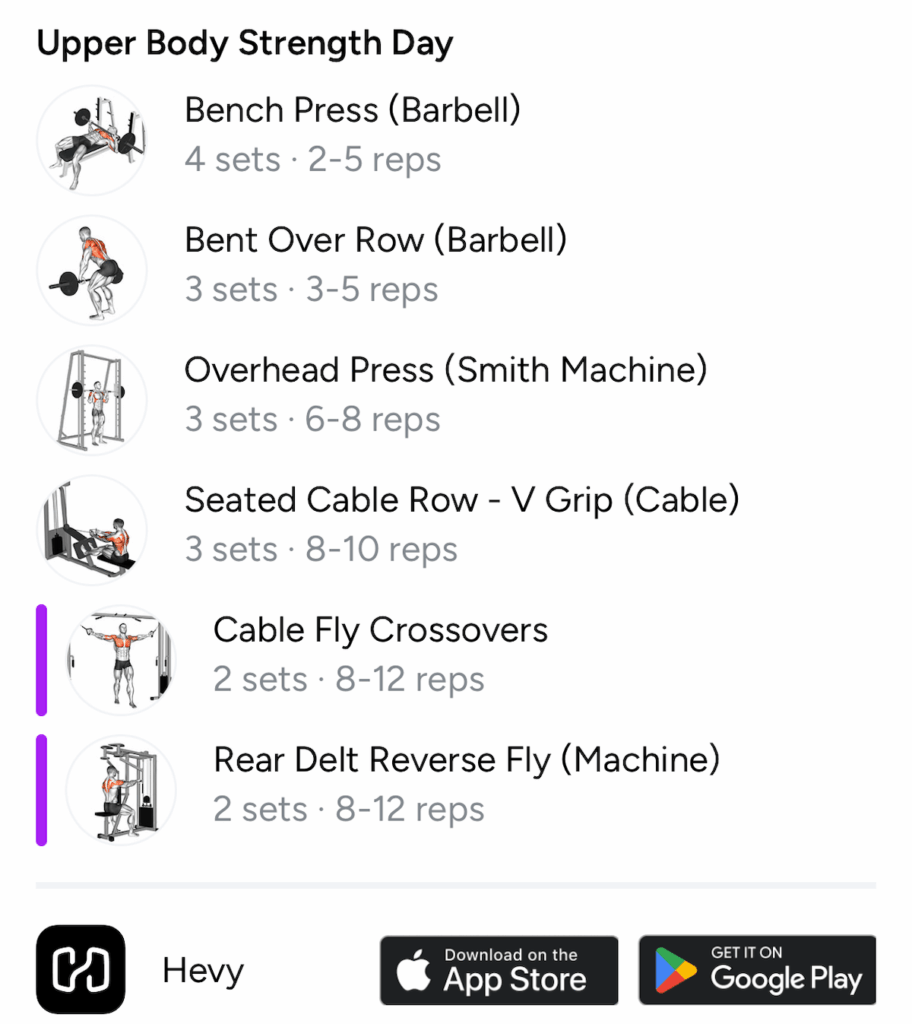
The bench press is your primary exercise, and you’ll use a 5/4/3/2 scheme (we’ll explain it below). You’ll then use the bent-over row with straight sets.
Then move to the Smith machine for an overhead press with 6-8 reps and a seated row. For the seated row, you can try different grips.
Finish up with a superset of chest and reverse flys. You can use cable or pec deck.
Save this whole split to your Hevy profile.
- Open hevy.com and log in with your app credentials. Skip if you’re on your phone and have already installed Hevy.
- Find the split here and tap the blue Save Folder button.
Lower Body Strength Day
| Lower Body Strength Day | |||
| Exercise | Sets | Reps | Rest Time (mins) |
| Squat (Barbell) | 4 | 5 4 3 2 | 3-5 |
| Deadlift (Barbell) | 3 | 5 3 1 | 3-5 |
| Leg Press (Machine) | 3 | 10-15 | 2 |
| Single Leg Romanian Deadlift (Dumbbell) | 2 | 8-10 | 1.5-2 |
| Lying Leg Curl (Machine) | 2-3 | 8-10 | 1.5-2 |
| Leg Extension (Machine) | 2-3 | 8-10 | 1.5-2 |
| Standing Calf Raise (Machine); optional | 2-3 | 8-10 | 1.5 |
| Hanging Knee/Leg Raise; optional | 2-3 | 8-15 | 1.5 |
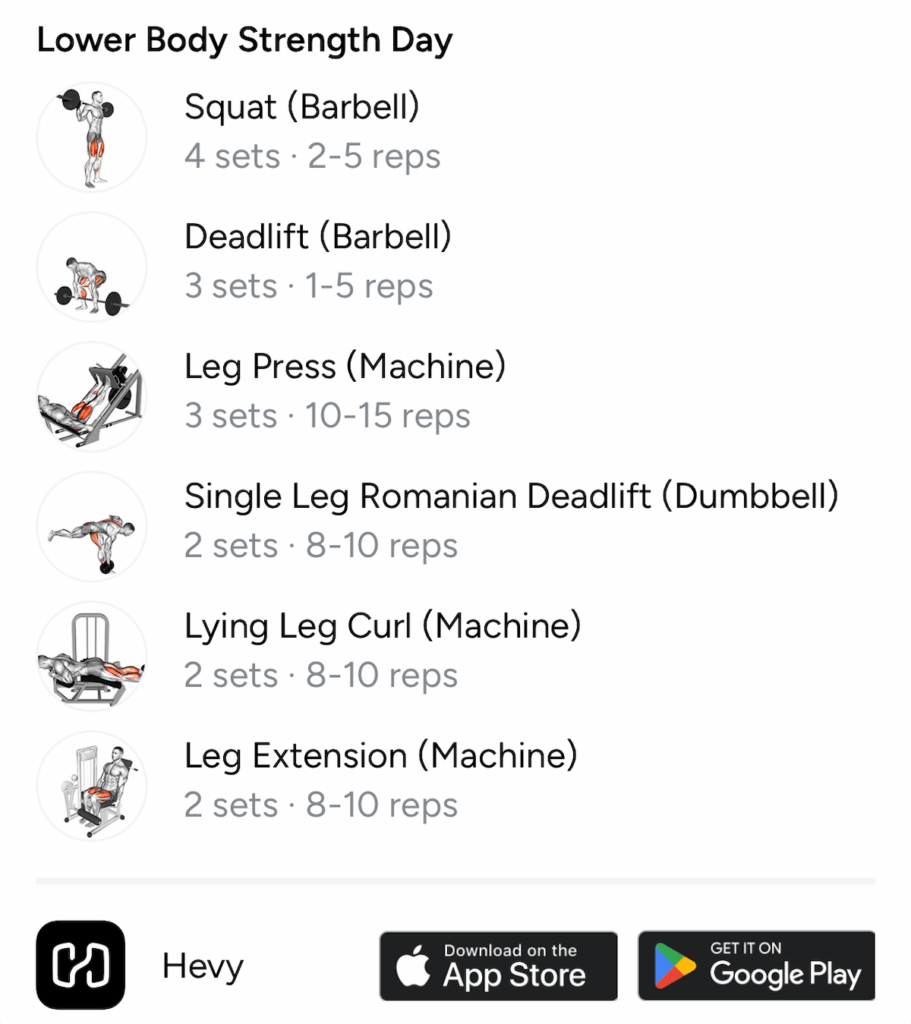
Your primary strength exercises are the back squat and the deadlift. These two exercises will make up the bulk of this session, as they can be demanding.
Afterward, you’ll perform some volume sets with the leg press and isolation work. This is also a great day to add core.
Upper Body Hypertrophy Day
| Upper Body Hypertrophy Day | ||||
| Exercise | Sets | Reps | Rest Time (mins) | RPE |
| Rack Pull | 3 | 6-8 | 2.5-3 | 7-8 |
| Incline Bench Press (Smith Machine) | 3 | 8-10 | 2-2.5 | 7-8 |
| Bench Press – Close Grip (Barbell) | 2 | 8-10 | 2-2.5 | 7-8 |
| Reverse Grip Lat Pulldown (Cable) | 3 | 8-10 | 2 | 7-8 |
| Lateral Raise (Cable) | 3 | 8-10 | 1.5 | 8-9 |
| Bicep Curl (Cable) | 2-3 | 8-10 | 1.5 | 8-9 |
| Overhead Triceps Extension (Cable) | 2-3 | 8-10 | 1.5 | 8-9 |
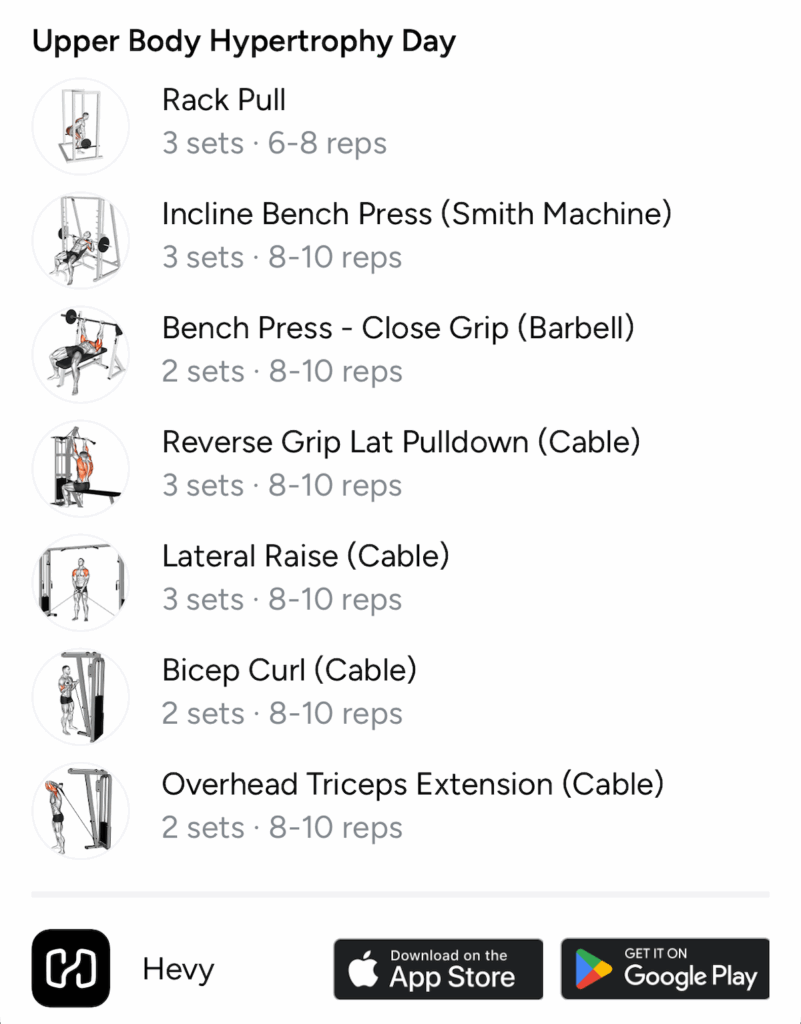
Used by the likes of Frank Zane and Jay Cutler, the rack pull is an often-overlooked exercise. However, it can be one of the best back exercises to add mass and width. As a bonus, it can further support the deadlift, making it a great exercise for powerbuilding, as it naturally benefits both size and strength.
Next, use the Smith Machine for the press. Afterward, overload the triceps with a close-grip bench press.
You’ll then use an underhand grip on the lat pulldown. A favorite of Dorian Yates and Mike Mentzer, think of this as a biceps exercise and focus on getting a good contraction.
Last, finish up with isolations. Do 3 sets of cable lateral raises and then choose 2 or 3 sets for the biceps and triceps.
Lower Body Hypertrophy Day
| Lower Body Hypertrophy Day | ||||
| Exercise | Sets | Reps | Rest Time (mins) | RPE |
| Romanian Deadlift (Barbell) | 3 | 8-10 | 2 | 7-8 |
| Squat (Smith Machine) | 3 | 8-10 | 2 | 7-8 |
| Bulgarian Split Squat (Dumbbell) | 3 | 8-10 | 2 | 7-8 |
| Glute Ham Raise | 3 | 10-12 | 2 | 7-8 |
| Lying Leg Curl (Machine) | 2 | 8-10 | 1.5 | 8-9 |
| Standing Calf Raise (Machine) | 3 | 8-15 | 1.5 | 8-9 |
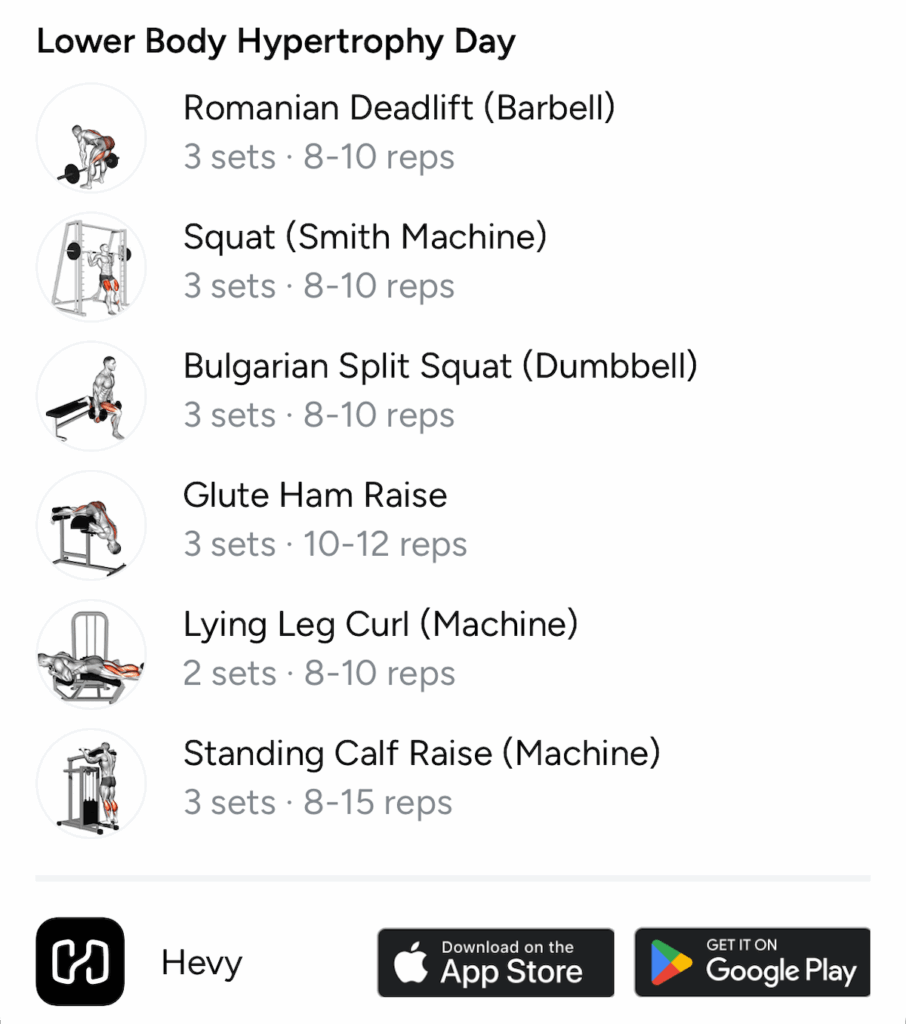
Your lower body hypertrophy day will start with the Romanian deadlift. You can use either dumbbells or barbells depending on what you like.
Next, move on to Smith machine squats and Bulgarian split squats, which will annihilate your quads. Then hit your hamstrings and glutes more with GHDs and a couple more sets of leg curls. Finally, end by hitting your calves.
Find the split here and save it to your Hevy profile (completely for free).
Sample 12-Week Powerbuilding Program
Rep Schemes For Strength Exercises
Bench Press & Back Squat (5/4/3/2)
Weeks 1-3 consist of 4 sets of increasing weight:
- Set 1 – 5 reps
- Set 2 – 4 reps
- Set 3 – 3 reps
- Set 4 – 2 reps
The primary difference will be the RPE used for each week:
- Week 1 – RPE 9
- Week 2 – RPE 7
- Week 3 – RPE 9-9.5
- Week 4 – Deload
Weeks 1 and 3 will be intense, with week 3 being the week you push it. In week 2, you want to concentrate on performing good, crisp reps while never crossing RPE 7.
Bent Over Row (3 x 3 or 5)
For your row, use straight sets of either 3 or 5 reps – you can choose depending on how you feel.
The important part is that you see a gradual improvement over time. Either way, stick to RPE 8 and concentrate on clean, crisp reps.
Deadlift
For your deadlift, you will perform 3 sets of the same number of reps, increasing the weight.
- Set 1 – 5
- Set 2 – 3
- Set 3 – 1
However, you will only perform one set of RPE 8+ on your 3rd set.
- Set 1 – RPE 6
- Set 2 – RPE 7
- Set 3 – RPE 8-8.5
4-Week Blocks
This 12-week program will include three 4-week blocks.
Week 1-4
- Week 1 – RPE 9
- Week 2 – RPE 7
- Week 3 – RPE 9-9.5
- Week 4 – Deload
Week 5-8
- Week 5 – RPE 9
- Week 6 – RPE 7
- Week 7 – RPE 9-9.5
- Week 8 – Deload
During this second block, you will have the option of swapping your hypertrophy exercises. To be clear, this can include any exercise other than the 4 primary strength exercises.
However, follow these rules:
- Your primary focus will be exercises you’re not seeing progress with
- You can swap other exercises if you want to add variety, but don’t change everything at once.
Week 9-12
Strength exercises:
- Week 9 – RPE 9
- Week 10 – RPE 6.5-7
- Week 11 – RPE 9.5
- Week 12 – Deload
You’ll repeat the process, with the option to swap exercises again. The one caveat is to be more conservative in week 10 and go a little harder in week 11.
Progressive Overload and How to Track Progress
Progressive overload is the foundation of every successful powerbuilding program. To continue building strength and muscle, your training must gradually become more challenging over time.
While adding weight to the bar is one form of progression, it’s not the only one. Performing more repetitions, improving technique, or increasing total training volume are all valid ways to progress (5).
Progressive Overload On Hypertrophy Exercises
Progressive overload for hypertrophy centers on increasing volume, with set-by-set performance improvements coming secondary (6). For most exercises, the “double progression method” is one of the simplest and most effective approaches. It manipulates both load and reps to increase work.
- Select your target rep range (say, 8-10)
- Select a weight that allows you to perform the lower end of your target rep range
- Each session, perform more repetitions while maintaining good technique
- Continue until you can complete every set at the top of the rep range
- Increase the weight by the smallest available increment and repeat the process
Here’s what it might look like using a 3 x 8-10 rep range. We highlighted the variables that are changed weekly:
- Session 1 – 3 x 8 w/ 100lbs
- Session 2 – 3 x 9 w/ 100lbs
- Session 3 – 1 x 10, 2 X 9 w/ 100lbs
- Session 4 – 3 x 10 w/ 100lbs
- Session 5 – 3 x 8 w/ 105lbs
Progressive Overload On Strength Exercises
Progression here can be similar, with the primary differences being a) you’re lifting a higher percentage of your 1RM, and b) you’re training in a lower rep range – say, 3-5 instead of 8-10.
Most trainees tend to add weight on the bar more quickly here because of the specific impact of heavy strength training on the body, which we discussed above (section “Why Powerbuilding Works”).
So, the process is identical:
- Select a rep range (say, 3-5 or 4-6)
- Pick weights you can do for at least 3-4 reps, depending on your rep range
- Each session, focus on doing more reps while maintaining good form, tempo, and range of motion
- Once you hit the upper end of the rep range on all sets, add load (you can also use micro plates if you feel “stuck” between two weights)
Here’s a sample progression:
- Session 1 – 3 x 3 w/ 200 lbs
- Session 2 – 3 x 4 w/ 200 lbs
- Session 3 – 3 x 5 w/ 200 lbs
- Session 4 – 3 x 3 w/ 205 lbs
Importance of Deloads
To prevent fatigue from accumulating indefinitely, you’ll deload every fourth week. However, you’ll reduce the training loads differently for your lifts.
- Strength lifts – reduce loads by 40-50%
- Other lifts – maintain no more than RPE 7 and no progressive overload
This allows your muscles, joints, and nervous system to recover before beginning another progression cycle.
At the same time, if you feel like you need to cut more load from the hypertrophy exercises as well, feel free. One of the hallmarks of a successful intermediate lifter is learning how to read their need for recovery.
RPE and Autoregulation
As you advance and use heavier weights, managing recovery becomes even more important, making RPE and autoregulation crucial tools.
- Autoregulation – adjusting your training load, volume, or intensity based on your performance and readiness that day rather than following predetermined numbers.
- RPE (Rate of Perceived Exertion) – a 1–10 scale used to rate how difficult a set feels, with 10 representing maximal effort and no additional reps possible.
In the simplest terms, autoregulation means you adjust your training depending on how you feel while RPE is a tool to do this.
If a weight feels unusually heavy, you can reduce the load slightly while staying within your target RPE. Or, if you’re feeling particularly strong, you may be able to increase the weight while maintaining the same level of effort.
Another way to use RPE, as done in this program, is to make it a training goal. Perform ramp-up sets of 3 reps until you hit a specific RPE.
This is a useful way to naturally control effort level while allowing a little more freedom.
What Happens When You’re Done?
Once you’ve finished the block, you have some choices:
1. Swap out the exercises. The easiest solution is to swap out the exercises. Just ensure you use similar movement patterns.
2. Switch exercise order. Instead of swapping exercises, switch the exercise order. For example:
- Lower body: Make the deadlift your primary exercise
- Upper body: Use a shoulder press as your primary exercise
3. Alter the ratio of strength and hypertrophy. This is an attractive option because it allows for periodization while still training for strength and hypertrophy. For example:
- First 12-week block – prioritize strength training with 8-12 sets focused on the primary lifts.
- Second 12-week block – prioritize hypertrophy training and use just 3 strength sets per major movement.
Exercise Substitutions
There are no mandatory exercises in a powerbuilding program, especially for your hypertrophy-oriented exercises. The key is to preserve the same movement pattern and create a similar training stimulus.
Substitutions for strength exercises should:
- Allow heavy loads
- Simulate movement pattern
- More specific than hypertrophy substitutions
Substitutions for hypertrophy exercises should:
- Use the same muscle and basic movement pattern
- More flexibility with equipment used
While the squat, bench press, and deadlift are considered foundational lifts, you can make excellent progress using alternative exercises if you’re limited by equipment, mobility restrictions, previous injuries, or personal preference.
Whether you use a barbell, dumbbells, cables, or machines, progressive overload and good technique matter far more than the specific exercise itself.
This is why we always give exercise alternatives in programs generated by Hevy Trainer, so you can have flexibility in your training by choosing similar exercises you prefer.
Push Exercise Substitutions
| Instead of | Try | Best For |
| Barbell Bench Press | Dumbbell Bench Press | Shoulder comfort, greater range of motion |
| Barbell Bench Press | Machine Chest Press | Stability, hypertrophy focus |
| Incline Bench Press | Incline Dumbbell Press | Shoulder comfort |
| Overhead Press | Dumbbell Shoulder Press | Mobility limitations |
| Overhead Press | Machine Shoulder Press | Stability, hypertrophy |
| Weighted Dips | Decline Bench Press | If dips irritate the shoulders |
Pull Exercise Substitutions
| Instead of | Try | Best For |
| Barbell Row | Chest-Supported Row | Lower back fatigue |
| Barbell Row | Seated Cable Row | Constant tension |
| Pendlay Row | T-Bar Row | Upper back thickness |
| Pull-Ups | Underhand Lat Pulldown | Building strength toward pull-ups |
| Pull-Ups | Assisted Pull-Up Machine | Beginners |
| Face Pulls | Reverse Pec Deck | Rear delts and upper traps |
Squat Exercise Substitutions
| Instead of | Try | Best For |
| Back Squat | Front Squat | Quad emphasis |
| Back Squat | Safety Bar Squat | Shoulder mobility limitations |
| Back Squat | Hack Squat | Lower back comfort |
| Front Squat | Goblet Squat | Beginners |
| Bulgarian Split Squat | Walking Lunges | Similar unilateral stimulus |
| Leg Press | Belt Squat | Reduced spinal loading |
Deadlift Exercise Substitutions
| Instead of | Try | Best For |
| Conventional Deadlift | Trap Bar Deadlift | Lower back comfort |
| Conventional Deadlift | Sumo Deadlift | Individual leverages |
| Romanian Deadlift | Dumbbell Romanian Deadlift | Limited equipment |
| Romanian Deadlift | Good Morning | Posterior chain development |
| Romanian Deadlift | 45° Back Extension | Lower fatigue accessory |
| Rack Pull | Block Pull | Lockout strength |
Upper Body Accessory Substitutions
| Muscle Group | Primary Exercise | Alternatives |
| Chest | Incline Dumbbell Press | Machine Press, Cable Press |
| Shoulders | Lateral Raise | Cable Lateral Raise, Machine Raise |
| Rear Delts | Face Pull | Reverse Pec Deck, Rear Delt Fly |
| Lats | Lat Pulldown | Pull-Ups, Machine Pullover |
| Mid Back | Chest-Supported Row | Cable Row, Machine Row |
| Biceps | Barbell Curl | Dumbbell Curl, Cable Curl, Preacher Curl |
| Triceps | Cable Pushdown | Skull Crushers, Overhead Extension |
Lower Body Accessory Substitutions
| Muscle Group | Primary Exercise | Alternatives |
| Quads | Leg Press | Hack Squat, Belt Squat |
| Quads | Leg Extension | Sissy Squat, Spanish Squat |
| Hamstrings | Leg Curl | Nordic Curl, Stability Ball Curl |
| Glutes | Bulgarian Split Squat | Walking Lunge, Step-Up |
| Glutes | Hip Thrust | Glute Bridge, Cable Pull-Through |
| Calves | Standing Calf Raise | Seated Calf Raise, Leg Press Calf Raise |
| Core | Hanging Leg Raise | Ab Wheel, Cable Crunch, Plank |
Substitutions don’t need to be identical but should train the same movement pattern. Consistency will always produce better results than forcing yourself to perform exercises that don’t suit your body or available equipment.
Nutrition and Recovery
Your results are determined just as much outside the gym as they are inside it. A well-designed powerbuilding program creates the stimulus for adaptation, but proper nutrition and recovery allow your body to actually build muscle and strength.
- Protein – aim for 1.6-2.2 g/kg (0.7-1.0 g/lb) of body weight per day to maximize muscle protein synthesis and support recovery (7).
- Calories – if building muscle is your primary goal, maintain a small calorie surplus of approximately 200-300 calories per day. This provides enough energy to support growth while minimizing unnecessary fat gain.
- Carbohydrates – consume adequate carbohydrates to replenish muscle glycogen and fuel heavy compound lifts. Most lifters perform best when carbohydrates make up the majority of their remaining calories.
- Sleep – prioritize 7-9 hours of quality sleep each night. Recovery, muscle repair, and hormone regulation all depend heavily on adequate sleep.
- Mobility and recovery – warm up before lifting, perform light mobility work for areas that limit your technique, and schedule a deload every 4-6 weeks to manage fatigue.
Training hard is only half the equation. Consistently eating enough, sleeping well, and recovering properly are what allow progressive overload to continue over the long term.
Common Mistakes
Even the best powerbuilding program can fall short if fundamental training principles are ignored. Avoid these common mistakes to maximize long-term progress.
Overemphasizing Heavy Singles (PRs)
Testing your one-repetition maximum too often creates fatigue without contributing much to muscle growth. This doesn’t apply to singles within a structured program, such as pulling singles with 90% 1RM. Rather, trying to set PRs every week with no plan is a good way to stall.
Most strength work should be performed in the 3-6 repetition range, reserving heavy singles for occasional testing or competition preparation.
Not Performing Enough Weekly Volume
Heavy compound lifts alone rarely provide enough volume to maximize hypertrophy. Accessory exercises are essential for reaching the recommended 10-20 hard sets per muscle group per week.
Tracking Weight But Not Reps
As you advance, applying progressive overload requires a bit more precision rather than guessing. This involves tracking your sets, reps, and loads, not just the weight lifted.
Some advanced lifters may train to add just one rep per set every couple of weeks.
Training Too Close to Failure
Grinding every set to failure quickly accumulates fatigue and reduces performance on subsequent exercises. Leave 1-3 repetitions in reserve (RIR) on most working sets to improve recovery and maintain training quality.
FAQs
1. Is powerbuilding good for beginners?
Most beginners don’t need a specialized training program to progress. А beginner following a basic progressive training program will increase strength and muscle size well. A beginner’s main goal should first be to learn proper technique on the primary lifts and build a solid foundation, sticking in the 6-12 rep range.
2. Can you build muscle and strength simultaneously?
Yes. Strength and hypertrophy are not mutually exclusive. A well-designed program that combines heavy compound lifts, sufficient weekly training volume, progressive overload, and proper recovery can improve both at the same time.
3. Can you powerbuild while cutting?
Yes, although progress is typically slower. Most lifters can maintain, and sometimes even increase strength while preserving muscle during a cut. This requires a moderate calorie deficit, high protein intake, and maintained resistance training intensity.
Conclusion
Powerbuilding is an effective training method for lifters who want to build strength and muscle without specializing in either powerlifting or bodybuilding. By combining heavy compound lifts, sufficient weekly training volume, progressive overload, and proper recovery, you can steadily improve your performance and physique at the same time.
Download Hevy to log your workouts and track progress closely. See how your strength improves on each movement and keep yourself accountable during training by seeing your previous training values and using the automatic rest timer.