Don’t make your first year in the gym harder than it needs to be. Learn the basics, check your ego, track your progress, and build habits you can actually maintain for decades.
Key Takeaways
- Warm up with purpose. A good warm-up should prepare your heart rate, muscles, joints, movement patterns, and nervous system—not simply make you sweat before lifting.
- Learn to load movements, not just move heavy loads. Build technique, control, and quality movement before chasing bigger numbers.
- Prioritize good form and full range of motion. Don’t shorten movements simply to disguise weakness. Build the mobility and strength needed to perform them properly.
- Learn from people who have actually lasted. Experienced lifters can teach you things that don’t necessarily show up in textbooks—consistency, intuition, balance, injury avoidance, and how to keep training for decades.
- Think long-term. There is no permanent “win” in fitness; the real payoff comes from making training sustainable enough to remain part of your life for years to come.
- Have a plan and track your progress. Whatever system you use, consistency and progressive overload are what ultimately drive progress. Hevy Trainer (Pro feature) can create a tailored plan that accounts for preferences, available equipment, and even injury history.
A Little Bit of My Early Days
I can replay my anxiety like it was yesterday. I was a 16-year-old kid who just got his first-ever gym membership at the Memorial Health Club in my neighborhood. Though I’d been into sports for as long as I could remember, lifting was a different animal.
I had some weights in my bedroom that I tried to mess around with at home, but I knew it was time to get more serious and have access to a proper setup for real results. In this world, my story (and journey) started at 16. Yours may be starting later – or maybe even earlier. The good news is, there’s no “perfect” time, and this should be the plunge you’re taking to start the beginning of the rest of your life – if you do everything smart.
That’s where this guide comes in handy, courtesy of a 19th-year coach with 23 years of lifting under his belt. Pulling a little bit from the science textbooks, a little bit more from coaching clients, and a lot from my own mistakes in the process, this will serve as your personal holy grail for a foolproof strength training journey that pays you top dividends. It all starts with taking smart first steps to steer you in the right direction.
What to Expect on Your First Day at the Gym
Your first day at the gym can feel intimidating because it’s a new environment, new people, and a set of rules you’re not familiar with. But the thing is, most gyms are filled with people focused on their own workouts, and nobody is grading you on experience, confidence, or performance. Still, feeling nervous is completely normal.
So, let’s go over some things to help you start:
What to Pack in Your Gym Bag
- Comfortable clothes you can move freely in
- Proper footwear, ideally flat and stable shoes with good grip
- A water bottle, since staying hydrated matters
- A small towel to wipe down equipment and yourself
- Your phone with Hevy installed to track your workout*
*Logging workouts is a great habit to get into because it allows you to track improvements, easily see what workouts you’ve done, and not rely on memory for all the small details.
Take a Quick Tour First
It’s perfectly okay to walk around the gym before you do anything. This is a new place, so it makes sense to get familiar with everything. Find the free weights, the strength machines, the cardio machines, and the open areas where you can warm up, stretch, and do some exercises more privately.
Machines typically have diagrams explaining the muscles that get worked, what movement patterns you can do, and how to set them up, but you can always ask gym staff to show you.
Getting familiar with the gym can make it feel far less intimidating.
Gym Etiquette Basics
Gym etiquette is like that of any other setting, with unwritten rules. These are good to follow, but don’t feel nervous if you mess up somewhere. Sometimes, even experienced gym-goers aren’t aware and don’t follow all the rules.
But always do your best to:
- Wipe down equipment after you use it
- Re-rack your weights: mainly dumbbells and weight plates you add to bars and plate-loaded machines
- Not hog equipment; take what you need, use it, and move on to the next
- Ask for guidance or support if you feel uncertain
- Ask for a ‘spot’; people are generally happy to help
A ‘spot’ is simply asking for a fellow gym goer to watch over you as you do an exercise like the bench press, so they can step in and help you complete a rep if you get stuck.
First Workout Expectations and Good Practices
The following tips will help you get into a rhythm and build confidence. They are not mandatory, nor are they the only “proper” way to work out. These are simply things I’ve found to help people loosen up, do some productive work, and be more likely to come back:
Effort and Intensity
- Exert yourself to the point of moderate discomfort. End each set feeling like you could have done 2-3 more reps if you had to. Stop any set if your form breaks down: losing your positioning, shortening the range of motion, relying on momentum, or feeling less in control of the weight.
- Start lighter than you think you need to. I’ll explain this a bit more below, but the gist is to check your ego at the door. Start with weights you can comfortably handle and don’t feel like you need to cover some arbitrary minimum.
- Focus on smooth and clean reps. Do reps with an even tempo and try to maintain a stable body position throughout. Breathe in before each rep and exhale as you exert yourself – for example, breathe in, push, and exhale as you do.
Planning and Structure
- Start with 5 to 10 minutes of light cardio. A bit of low-intensity cardio to start is a good way to warm up (more on that below) and feel more comfortable in the new environment. Treadmill walking, stationary cycling, and the elliptical are all good options. Maintain a low intensity until you feel slightly out of breath.
- Use guided machines for stability and proper form. Machines are a good starting point not because they are inherently better but because they are more beginner-friendly by providing a guided movement pattern, a specific range of motion, and stability.
- Rest for at least 60 to 90 seconds between sets. Don’t rush the workout because you feel out of place. Take your time to recover between sets, so you can maintain performance throughout the workout.
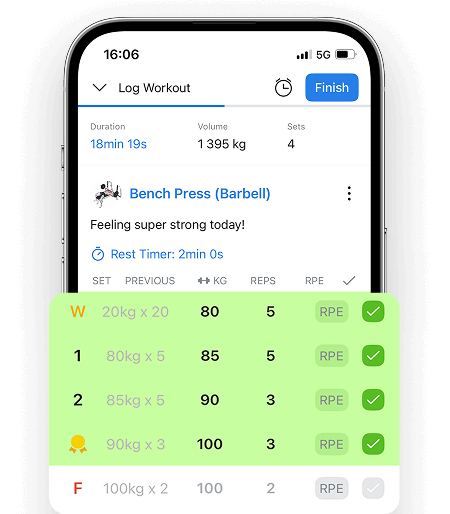
- Log your weight and reps on each set. Once done with a set, take 10 seconds to log it. It’s a fantastic way to have concrete data of what you’re doing and make sure you progress in upcoming workouts.
- Work out for at least 30 minutes, preferably 45 to 60 minutes. You can have a productive session in half an hour, but staying a bit longer can help you get more comfortable with the gym setting and boost your chances of coming back.
- Do a simple workout and go in with a plan. Find a few relatively simple exercises for major muscle groups, do 3 sets of each, and call it a day. For example, chest press, leg press, seated cable row, and seated leg curls. Four movements, 12 total sets, and most of your body is trained.
Hevy’s free routine library offers beginner-friendly workouts and programs you can follow. For a more tailored experience, try Trainer (Pro feature). Answer some questions about your main goal, preferred workout frequency, workout duration, and available equipment to get a custom plan you can start doing immediately.
Comfort and Confidence
- Visit during less busy hours. Mid-morning and early afternoons are less busy at most gyms.
- Feel free to use headphones. Listen to a podcast, audiobook, or your favorite songs to focus and feel more comfortable.
- Go with a friend if possible. Even if you’re both inexperienced, having a friend there can be of massive support and help you build early momentum.
- Ask gym staff for help. Can’t figure out a machine or are unsure about an exercise? Ask the staff for a bit of help – they get asked all the time.
- Don’t compare yourself to anyone. Don’t compare your day 1 to someone’s day 2,357. Everyone is there to better themselves, so don’t feel bad for being at the start of your fitness journey.
6 Tips For Your First Day at the Gym (And Beyond)
Tip 1: Never forsake your warm-up.
Especially if you’re young, this may be the sneakiest dark horse to derail your training quality and progress, simply because you feel invincible. The truth is, your workout is only as good as your warm-up. What you did in high school gym class doesn’t count either.
Many people think warming up means getting out of breath or breaking a sweat. Others think it means “doing a set with the empty bar” before starting to load up. Both of these are only a small piece of a bigger pie. Instead of doing a five-minute jog on the treadmill and bench pressing 10-pound dumbbells, understand that warming up smart is part of training smart.
There are 5 key goals every warm-up should accomplish:
- Increase heart rate. That means getting moving enough to get above “resting.” So static stretching on the ground isn’t gonna help you achieve this.
- Increase muscle temperature. This too involves some movement. Luckily, achieving everything else on this list will allow this to be fulfilled by default.
- Release synovial fluid. That’s the fluid that lubricates your load-bearing joints. Dynamic stretching and mobility-based work will be king here.
- Movement preparation. Simply put: If you’re squatting or pressing, your warm-up should include something that mimics those patterns (i.e., warm-up sets).
- Activate the central nervous system. If you’re about to lift big weight, it’s going to ask a lot of the sharpness and readiness of your motor units, nerves, and fast-twitch fibers. Including something that’s quick, powerful, and snappy is worth its weight in gold for your warm-up.
This seems like quite the list, but the truth is, accomplishing all of the above in an effective warm-up shouldn’t take much more than 6 or 7 minutes.
Here’s a quick example of a total-body warm-up consisting of high-knee walks, spider-man walks, deep squat with overhead reach, plyo (or regular/kneeling) push-ups, and jump squats (or regular squats).
- High Knee Walks – 15 meters
- Spider Man Walks – 15 meters
- Deep squat with overhead reach – 6 reps
- Plyometric push-up – 6-8 reps (this is more advanced, but a classic push-up or even kneeling push-ups can also work the same)
- Jump Squat – 8 reps (regular squats, going as low as you comfortably can, also work)
One round of each of these, and you’ll certainly be feeling strong and ready to lift.
Tip 2: Learn to load movements, not move loads.
One of the most important distinctions you’d be smart to learn on day 1. But what does it mean? It’s simple: It means it’s time to check your ego early.
Chasing progressive overload and pushing yourself in the weight room is an essential part of making gains, but it should be handled responsibly, not recklessly.
When you’re focused on moving loads, it shows that the main priority is lifting as heavy weights as possible, often at the expense of good technique and safety. Not only is this inherently risky on the injury side, but it’s also an inefficient way to actually get strong and more muscular.
To contrast, loading movements puts the patterning and technique first – which is a fancy way of saying it ensures quality control. This would mean applying principles such as controlled tempos, pauses, and doing movement variations that create the most mechanical tension.
Take the squat as an example. You have two paths forward:
- Add as much weight as possible.
- Drop to the bottom position quickly and lean too far forward.
- Bounce off the bottom and rely on hip extension to get back up.
- Cut the depth as the bar gets heavier.
Or:
- Take a lighter weight.
- Set up correctly: feet slightly more than shoulder-width apart, toes pointing slightly out, core braced, and shoulders back.
- Descend slowly and with the aim to maintain an upright torso and get to a certain depth – typically until your thighs are parallel to the ground.
- Pause briefly at the bottom, then move back up, aiming for all reps to look identical.
Same exercise, same movement pattern, but the second path lets you maintain muscle tension, build real strength, and set yourself up for much more weight on the bar in the long run.
Once you develop a proper foundation with correct technique and quality movement, you’ve earned the right to start adding weight to the movement. Long story short, stop testing your strength, and start actually training it.
Tip 3: Form and range of motion (ROM) above everything.
One of my biggest pet peeves is seeing a novice lifter make any necessary modifications to “make the lift.” Most frequently it comes in the form of cutting range of motion due to nothing other than avoiding vulnerable, weaker positions:
- Chin-ups stop at 90 degrees instead of descending to a full hang
- Squats are quarter-reps
- The bench press bar hovers several inches above the chest
All to attempt to disguise the fact that the main culprit at play is lifter weakness.
If you do this kind of thing, you’re selling yourself short and giving yourself a horrible foundation to build off of. No one got big and strong off bad form and half-reps. And good-quality lifts require the mobility and flexibility necessary to use the intended range. If you think you have an issue in these departments, you probably do.
Make it so your mobility and flexibility are on point enough to warrant a full-range, good-looking exercise. Squats should see your hamstrings cover your calves. Bench press bars should go to the chest. Chins and rows should be complete pulls from a full reach. Make using partial range a choice, something you want to do for a specific training effect. Not something you have to do because of poor conditioning.
If you’re not there yet, here are a few ways to work toward full range of motion:
- Lower the weight until you can move through the full range of motion. For squats, aim to improve the depth a little bit at a time while maintaining a neutral spine and keeping your heels on the ground.
- Use pauses. Hold the bottom position of a squat or push-up for 2-3 seconds to get comfortable in the weakest position.
- Use assistance. Try an assisted pull-up machine, a band, or the lat pulldown to work toward a full hang on chin-ups.
- Use a box or bench to standardize your reps and depth. Place a plyo box behind you for squats and try to touch it lightly with your buttocks at the bottom of each rep.
- Film some of your training from the side and review. This often reveals more than you can feel while doing an exercise.
- Reach out to a personal trainer or an experienced lifter. Ask for some guidance on proper form, setup, and breathing.
Tip 4: Have a plan, and track your progress.
Content on the internet – or even in real life – can end up confusing a new lifter into wondering just what to do to get the most out of the effort put into chasing gains. When the name of the game is getting bigger and stronger, the truth is that the simple basics work best.
And most importantly, regardless of what program or system you choose, the thing that matters most is consistency with that program or system. The beauty about any structure is that at the end of the day, the goal is the same: To make progress using the progressive overload principle.
But what is progressive overload?
This concept is literally the only way to make muscles grow or get stronger. Not applying this principle will result in a lifter spinning their wheels and staying the same from a physique and performance perspective, so it’s imperative to implement it if you’re not looking to plateau.
Doing this in your workouts means consistently challenging the muscle with loading that provides enough stimulus to trigger a growth response. Put simply – you make sure the set is hard enough.
Let’s say you can do a press with 30 pounds for 8 reps. If the reps look clean and the 7th and 8th reps look the same as the first reps of the set, it’s time to apply this principle, because the loading didn’t cause you to work any “harder” at the end of the set. Your first option would be to take that 30 pounds and perform more repetitions than your originally intended 8.
If you can successfully perform 10 tough reps instead of 8 with that same weight (this may take a couple of weeks of trying), this is an indication that you’ve succeeded at one form of progressive overload, and you’re ready for the second form: Adding load and reducing rep range to match.
Doing that would look like this: In the following workout, increase the weight from 30 pounds to, say, 35 pounds. You clearly won’t be able to grind out 10 reps with that weight since it’s heavier than before (you last did 10 tough reps with 30).
This new loading will probably give you the same level of difficulty in just 8 reps. So you’ll be at 35 x 8 reps, and you’ll be restarting the same game as before; aiming to eventually complete 10 tough reps with that 35-pound weight, before increasing to 40 or 45 and reducing the reps back down to 8.
Here’s the whole progression at a glance:
| Step | Weight | Reps | What it means |
| Starting point | 30 lbs | 8 | Reps 7 and 8 look as clean as rep 1. The set isn’t hard enough yet. |
| Add reps | 30 lbs | 9 | Same weight, one more rep. The last reps start to feel tough. |
| Goal reached | 30 lbs | 10 | 10 tough reps with clean form. You’re ready to add load. |
| Add load | 35 lbs | 8 | Heavier weight means fewer reps for the same difficulty. |
| Repeat | 35 lbs | 10 | Work back up to 10 tough reps, then move to 40 lb x 8. |
This is the principle that will make or break your training, and, to be clear, it’s not limited to sets of 8 to 10, as I showed in my example. No matter whether you’re lifting your 3 rep max, your 10 rep max, or your 15-20 rep max, the same principle applies.
Tracking progress is essential for accountability and keeps you on the right track for your gains. It’s one of the smartest things you can do to stay on point. The Hevy app can be the quintessential tool to help that process, make it simple, and keep your tracking organized.
Tip 5: Learn from the vets.
This subject is nuanced. At face value, you may think I mean that getting better, seeing progress, and gaining knowledge at the gym will come from studying with experts in the field – veteran trainers who have earned their stripes through years of practice.
Or at the very least, professional powerlifters, Olympic lifters, and bodybuilders who’ve dedicated their lives to the competitive sport of training with weights.
Don’t get me wrong – there is a lot to learn from each of these demographics. But that’s not the kind of veteran I’m talking about.
I’m talking about the 65- or 70-year-old member at your local gym, who looks great for his or her age. The person who’s clearly lasted the test of time and has been training for 50 years, and has the physique to show for it, and performance that can rival someone 25 years younger.
The amount of wisdom a person like this has to share when it comes to real-world application – training intuitively, learning your body, staying consistent, respecting the process, taking care of the little things, understanding and appreciating balance between training and life, making mistakes, avoiding injuries, diversifying your training portfolio, just to name a few subjects.
These conversations will be worth their weight in gold for your longevity in the fitness sphere, and you’re going to be learning from walking, talking examples of exactly what you want.
Tip 6: Understand it’s the long game, and you never “win.”
To go hand in hand with the above, it really behooves us to remember that when it’s all said and done, there’s no “victory” when it comes to this. The win comes from never stopping. Conquest and contentment come from making training and fitness a routine part of your daily life.
It’s nice to think about being the biggest guy in the room, the strongest lifter in the gym, or the leanest person walking around, but each of those things has a shelf life, an expiry date, and doesn’t look at the bigger picture.
In the name of your health, make your fitness goals sustainable. Push for gains, but remember not to miss the forest for the trees. If you can’t see yourself training, recovering, eating, and balancing everything the exact same way 15 years from now, it’s worth reassessing and finding a way to make it realistic. Don’t make rookie mistakes that cost you time being healthy.
Your First Workouts: Ideas & Further Reading
Workouts don’t need to be fancy. They need to be hard enough to create a stimulus, but not overwhelming. Most importantly, they need to feel enjoyable and productive.
Check out these resources for more workout plan ideas and inspiration (as well as splits you can save directly on Hevy and start logging today):
- Upper Body Workouts for Beginners (+3 and 4-Day Splits)
- 7 Free Workout Plans for Every Fitness Level (With Examples)
- 2 Day Workout Split Workout – The Complete Guide
- Upper/Lower/Full Body Split (3x/Week Program)
And read our guide to learn what beginner gains are and how to maximize your results in the first year of training.
FAQs
1. How should a beginner start at the gym?
Start small and keep a simple fitness routine. Plan your first gym workout in advance, warm up for 5 to 10 minutes, and do a full body workout using strength machines and light weights. Focus on technique before adding weight, and aim for two to three sessions in your first week and beyond. Working out with a friend can also help with motivation.
2. What should I expect after the first day at the gym?
Mild muscle soreness for a day or two is completely normal, especially in your legs and upper body. Light walking and staying hydrated can help you feel better. (Sharp pain, swelling, or pain in a joint is not normal.) Show up for your next session even if it’s a lighter one, since consistency matters more than intensity in the first few weeks.
3. How long should a beginner workout take?
About 45 to 60 minutes, including your warm-up and cool-down. Rest 60 to 90 seconds between sets. If you’re short on time, a shorter, focused workout is far better than skipping the gym session altogether.
Conclusion
Your first day at the gym doesn’t need to be perfect. Warm up properly, load the movement rather than chase heavy numbers, use as close to full range of motion as mobility allows, and track every session so progressive overload does its job.
Keep the workouts simple, stay patient, and lean on people and tools that can guide you. Do that, and this will be the start of a fitness journey you’ll still be enjoying decades from now.
Check out Hevy’s free library with 26 complete programs for all levels, as well as Trainer – our algorithm that creates custom training plans with progressive overload built-in. Enjoy a smooth workout logging experience, with step-by-step instructions and demo animations to help you learn proper form at the gym.