When starting at the gym, most beginners make the same predictable and fixable mistakes. These early missteps can lead to slow progress, frustration, and sometimes quitting entirely. Avoiding them can save you months of frustration.
Here are 11 common strength training mistakes and exactly what to do about them.
Key Takeaways
- Beginners often do too much too soon. This is a fast path to burnout, so pace yourself when you start working out. Aim to train around 3-4 days a week in 40-60 minute blocks, leaving some energy to spare at the end of each session.
- Simply going with the flow can lead to muscle imbalances and limited results. Train with a plan and follow a structured program that tells you what to do and when. This removes guesswork and keeps you accountable.
- Avoid sticking to the same weights and reps; utilize progressive overload to build muscle effectively. Your body only adapts when you give it a reason to, so you need to push for more over time. Aim for 1-2 extra reps or slightly more weight every week or so, without sacrificing form.
- Training with poor form limits your results and increases injury risk. Focus on good technique by reducing the weight until you can control your reps, and only add load when your form is solid.
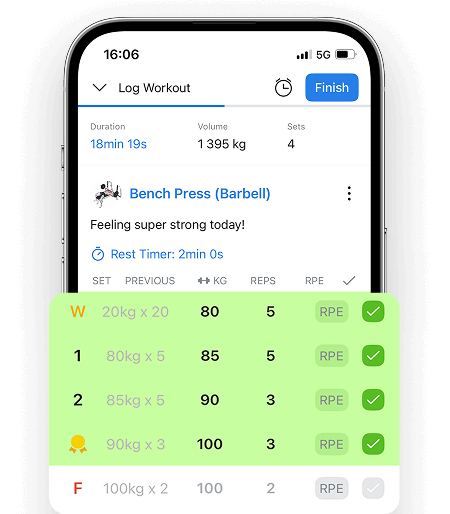
- Relying on memory to record your exercises, sets, reps, and weights is impossible, so log every session. A few seconds per set creates a feedback loop that tells you what’s working and what isn’t.
11 Common Beginner Gym Mistakes (& How to Fix Each)
1. Not Pacing Yourself
Doing too much too soon can affect your motivation and consistency. Beginners often equate more work with better results, but the early motivation can cloud your judgment on the sustainability of your program. Planning your workout routine around sustainable choices can help you avoid burnout and injury.
Let’s say you join the gym and train 6 days a week for over an hour each time. The first week might feel great; you’re full of adrenaline, and the new environment is novel and exciting.
By week 2 or 3, soreness has started to accumulate, and you might feel generally fatigued and frustrated. By this point, your gym sessions might have stalled entirely, and you end every workout exhausted and unsatisfied.
This is, sadly, a point where many beginners quit entirely. They think the gym is simply too exhausting, and they’ll never be able to keep up. To avoid this fate, start slow and steady with long-term habits in mind.
Finding out what works best for your fitness goals and schedule is often the best approach, but these recommendations are a good place to start:
- Committing to 3-4 sessions a week is plenty and leaves recovery days for your body to adapt.
- Around 40-60 minutes per session allows you to complete your session without attention drifting and excessive fatigue.
- Choose 2-3 exercises per muscle group each session, with about 3 sets per exercise.
- Find the right training intensity that keeps you feeling strong throughout the session.
Remember that a good workout should leave you feeling tired but accomplished. If you’re completely exhausted, you might need to take more time to recover.
2. Weight Training Without a Plan
Showing up and figuring it out beats skipping a session entirely, but there’s a smarter way to go about it. Training without a solid plan has many drawbacks. Some muscles will get far more attention than others, because you default to what’s enjoyable.
Gravitating towards exercises that feel easy or fun, while skipping fundamental movement patterns, can slow your overall progress.
A classic example is a gym bro who trains chest and arms almost every day, but never trains his legs or glutes. Over time, the neglected muscles can cause uneven stress on his knees or lower back and create difficulty for lifts he may actually want to improve (not to mention the unevenly developed physique).
Missing a workout also doesn’t feel like an issue because you don’t have a specific structure to follow. With a plan in place, skipping a session feels like you’re missing out on progress. Without a plan, there’s nothing to miss.
Having a structured program removes guesswork and decision fatigue, making sure you know exactly what to do and when. It also serves as a benchmark for assessing whether you are progressing.
When each session has a purpose, you’ll feel greater accountability and a sense of achievement. Your plan doesn’t need to be complicated or overwhelming. Find a simple workout split with set exercises that you can commit to and execute repeatedly.
3. Program Hopping
Having a plan matters, but you need to stick with it long-term to see real results. Program hopping is just chasing the next ‘shiny object’ in your training. It’s essentially training without a plan, but with extra steps: there is technically a program in place, but it doesn’t stick long enough to matter.
This common trap often happens due to impatience with results or FOMO. You see someone online doing something you’re not, and want to change everything to match that new idea.
With no structure, your body never gets a chance to adapt, and progress becomes very difficult to track. You don’t know if you’re actually getting stronger or just learning new movements.
This invites a constant learning curve, meaning you spend more time figuring out what to do than actually training hard.
Pick a suitable, sensible program, and commit to it for at least 6-8 weeks. Judge progress by whether you’re getting stronger, and add reps or weight in key movements, but don’t completely overhaul the program on a whim. Switching plans should only happen after a meaningful period, not every other week.
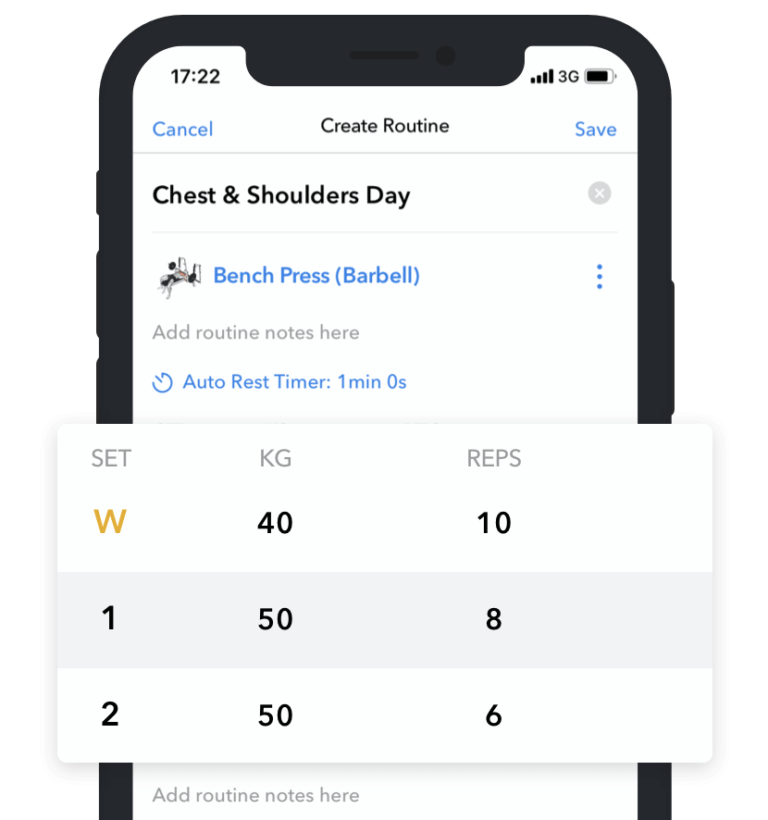
If you’re looking for a good, sustainable, and flexible program that accounts for your main goal, preferences, available equipment, and even injury history and comes with ongoing guidance and analytics, check out Hevy Trainer (Pro feature).

4. Not Progressively Overloading
Progressive overload is simply doing more over time: more weight, reps, or sets in your sessions as you adapt to training.
Progressive overload is essential for muscle growth because it continuously introduces new challenges, forcing your body to adapt to increasing demands. Beginners can often miss this by repeating the same workouts with the same weights over and over.
Repeating a comfortable routine indefinitely can still feel productive, because you’re showing up consistently and working out, but nothing is moving forward. If you’re lifting the same weight for the same reps for an extended period, say multiple months, your body likely adapted to that stimulus a long time ago.
The exception is during fat loss; maintaining your strength while getting leaner is a form of relative progress. But in a surplus or maintenance phase, you need to add weight or reps. That said, don’t sacrifice your technique or range of motion for the sake of “moving” more weight.
Plan your program around progress and track your lifts so you can see where you’re improving.
5. Training With Bad Technique
Training with poor form shifts tension away from the target muscles and increases the risk of injury, especially with heavier loads. Inefficient movement patterns can become habits that are difficult to correct down the line. This often comes from chasing higher weights at the expense of good execution.
Common signs of poor technique include:
- Half-reps – cutting the full movement of an exercise, for example, not reaching full depth on a squat, to handle more weight.
- Using momentum – bouncing weights, like springing the bar off your chest during a bench press.
- Swinging motions – not fully controlling your reps to make them easier, like swinging your dumbbell curls.
- Rounding the lower back – sing your back instead of your core on certain exercises, such as a deadlift.
If your technique is off, you might feel the movement mostly in the wrong areas and experience joint pain and discomfort during or after exercise.
To ensure you are using proper form, stop lifting too much weight. Reduce the load to one you can control, and focus on using an even tempo throughout the whole movement. Consider filming your sets and comparing them to technique guides, and only add weight when you have good form. Using mirrors at the gym can also help correct your lifting form.
If you’re really struggling to get your form right, consider reaching out to a coach for professional advice.
6. Not Knowing How to Brace Your Core
Not knowing how to brace the core is a common issue among beginners. Most people have never been taught how it feels or why it’s important, and it takes practice to get it right.
Bracing your core encourages intra-abdominal stabilization of the spine, especially during loaded movements. It protects the lower back during squats, deadlifts, overhead presses, and other compound exercises.
Sucking in your stomach is not bracing your core, and the sooner you break this habit, the better.
To brace, imagine breathing in and filling your entire trunk with air and tension, instead of pulling your belly button back towards your spine. Inhale deeply and expand your midsection in all directions, and feel your abs, obliques, lower back, and pelvic floor muscles tense.
Think about bracing yourself as if you’re about to get punched in the stomach, or pushing outwards against an imaginary belt.
Practice exercises like dead bugs to keep your core engaged while moving. When doing an exercise like lying leg raises, if your lower back arches off the floor, your hip flexor muscles are likely taking over. Learning to keep your lower back pressed down forces the abs to engage properly.
Bracing is highly practical in compound exercises. In a squat, a properly braced core prevents lower back rounding and keeps your torso rigid. When performing an overhead press, a braced core prevents excessive arching in the lower back.
It’s also important to practice proper breathing techniques. Inhale and brace before each rep, exhaling as you lift, and reset at the end of each rep, especially on heavy compound lifts.
7. Not Resting Enough Between Sets
Not resting enough can undermine your performance in upcoming sets. With enough rest, you can build up more volume and train harder without feeling exhausted. Short rests (less than 90 seconds) can help with muscular endurance training (1), but can also affect your ability to perform later on in the session.
Longer rest periods tend to favor slightly better outcomes for muscle growth (2). Resting longer also allows for higher-quality sets, and you may be able to lift more weight or hit more reps than if you rush.
For heavy compound lifts like the squat, deadlift, and bench press, rest for around 3-5 minutes between sets. For moderate compound lifts or machines, you can cut this down to around 2-3 minutes. Read our guide on optimal rest times.
Isolation exercises like curls, lat raises, and triceps extensions may benefit from a slightly shorter rest time of 1-2 minutes, since they involve fewer muscles. Use a timer to keep you on track if you tend to rush or get distracted between sets. Hevy’s automatic rest timer is also great because you can set a default value and get notified when it’s time for the next set.
8. Sticking to One Repetition Range
Many beginners lock themselves into a single rep range because they’ve been told it’s the only way to build muscle. But the number of reps you do matters less than most people think.
Research shows that muscle growth can occur across a wide range of loads when sets are taken close to failure (3). The key variable here is effort, not the precise number of reps.
Heavier weights (5-8 reps at around 80% of your 1-rep maximum) are good for building strength, neural efficiency, and developing confidence under heavy load. Going lighter (12-20 reps) is easier on your joints, lets you add more volume with less fatigue, and can improve power and endurance.
Both of these loads and rep ranges contribute to muscle growth. You can build muscle with heavy, moderate, or light loads, as long as you’re doing enough quality reps and sets. There is no ‘perfect’ rep range, and you will benefit from incorporating a variety of ranges into your training.
Compound exercises can work better for heavier training, whereas isolation work is typically safer in the 10-20 rep range. This is by no means a hard rule. Experiment to find what feels controllable and productive.
Sample Workout With Rep Ranges:
| Exercise | Sets | Reps | Load Focus |
| Barbell Squat | 3 | 5-8 | Heavy |
| Romanian Deadlift | 3 | 8-12 | Moderate |
| Leg Press | 3 | 12-15 | Moderate-Light |
| Leg Extension | 2 | 15-20 | Light |
9. Believing in “Must Do” Exercises
There are no compulsory exercises for general fitness, muscle building, and athleticism. If you don’t enjoy a commonly prescribed movement, there are likely many alternative exercises you can incorporate.
The only exceptions to this rule are for competitive powerlifters and Olympic weightlifters, who have to train specific lifts for competition.
There are multiple ways to train the same muscle group. For example, the squat pattern can be trained with back squats, front squats, goblet squats, leg press, and Bulgarian split squats. All of these options can build leg strength and muscle.
The best choice is often the one that works for your body and that you can do consistently. Find the exercises that feel good and produce results; trial and error in this process is completely normal, and not every exercise will be a winner.
As long as you can perform the movement with good technique, progress over time, and enjoy it enough to stick to it, you’ll be able to build muscle and strength effectively. If an exercise isn’t enjoyable or moving you toward your goal, consider replacing it. Here’s a simple framework to consider if you should swap an exercise:
| Keep Doing an Exercise If: | Consider Replacing an Exercise If: |
| You can perform it with consistently good technique | You can’t establish good technique |
| You can progress it over time | Another exercise trains the same muscle better for you |
| You feel the target muscles working | You can’t comfortably achieve the intended range of motion |
| It doesn’t cause pain | It consistently causes pain |
| You enjoy it enough to stick with it | You hate it (this is an absolutely valid reason) |
As an example, the barbell bench press is often treated as a must-do chest exercise. However, if bench presses hurt your shoulders or you don’t enjoy them, you can still build your chest with alternatives.
Instead of a barbell, try doing a dumbbell bench press, or swap to an incline press, machine press, dips, push-ups, or cable flys. The same logic applies to any other ‘essential’ exercises.
10. Not Logging and Tracking Your Training
It is impossible to remember all the details of a session in your head. Without a record, you’re guessing whether or not you’re making progress. Each session consists of exercises, sets, reps, weight, rest times, and even RPEs. You might remember the gist of last week’s workouts, but what about a month ago?
You can’t use progressive overload on something you don’t measure, so you have no clear direction on whether you’re getting stronger.
Logging takes a few seconds per set; tapping or typing on your phone or writing something down is quick and easy, and turns training into a feedback loop where you can see what’s working and what’s not.
Tracking your sessions is common today, and isn’t seen as ‘strange’ or ‘obsessive’ behavior. It’s simply a smart way to train and build on your progress.
A physical logbook works, but a digital logging app is faster and can show you more valuable trends and insights. Apps track session times, let you view your session history, calculate overall volume, and keep all your information stored in one place.
Hevy handles your logging in a clean interface, so you can focus on the session and track as you go.
11. Not Warming Up
Warming up your muscles and joints prepares them for the upcoming load. Skipping a 5-10 minute warm-up isn’t worth the time saved.
Warming up primes the mind for training and prepares your body for the movement patterns you will perform. It helps you gradually ramp up to the first few sets, practice good form, and scan for aches and tightness before they become a problem under heavy load.
Not warming up can also increase your risk of injury, as your body isn’t prepared for the upcoming exertion. Walking into a heavy squat or bench completely cold is unlikely to result in ideal performance or safety.
So, how to warm up? Here’s the gist:
Start with a general warm-up of 3-5 minutes, doing light cardio like cycling or dynamic movements (leg swings, arm circles, bodyweight lunges, resistance band pulls). Follow up with specific warm-up sets: do 1-3 sets with an empty bar or very light weight, then ramp up towards your working weight.
If, for example, your working sets use a 10 kg dumbbell for goblet squats, you can start with 10 reps of bodyweight squats, followed by 5-10 reps with a 6-8 kg dumbbell, then use your working weight.
Keep the warm-up short, purposeful, and not too tedious or tiring.
Why do People Keep Repeating the Same Gym Mistakes?
Beginners often fall into the traps of online influence, unrealistic expectations, poor planning, or comparison to more advanced lifters. This can make them stall or jump between different approaches.
Social media, online forums, and fitness influencers all push different approaches to training. It can be difficult to cut through the noise and find legitimate advice.
Beginners also often expect dramatic changes quickly, and start off doing too much to force progress. The body doesn’t work on a deadline, so instead of rushing for results, take pride in the fact that you’re slowly building your fitness and physique.
Comparing yourself to someone with years of training experience is needless and creates unnecessary pressure to keep up. Trying to match an experienced gym buddy’s workout, weights, or frequency is simply chasing numbers at the expense of good form and quality.
The gym isn’t a competition against anyone but yourself. Everyone is on a unique and personal fitness journey.
Without a clear workout plan, you might default to chasing the next exciting idea. A simple system, with similar exercises on the same days, adds structure and removes guesswork. Avoid over-complicating your routines; while this can feel exciting, it is rarely sustainable.
Finally, without tracking your progress, there’s no reliable way to know whether you’re getting stronger, whether your volume is increasing, or whether a specific exercise is actually working. This guesswork can kill motivation faster than slow progress.
FAQs
1. What are the most common workout mistakes among beginners?
The biggest and most detrimental beginner gym mistakes are doing too much too soon, training without a plan or constantly switching programs, neglecting progressive overload, using bad technique, and not tracking your workouts. All of these are fixable once you know what to look for.
2. How do I know if I’ve rested enough for my next set?
You’re likely ready when your breathing has settled, you feel focused, and the target muscles feel recovered enough to give a quality effort.
Trusting your own sense of readiness can produce similar performance outcomes to fixed rest periods (4). You can generally trust your body if you don’t track rest specifically, as long as you’re honest about how rested and prepared you feel.
3. What is the best way to learn proper exercise technique?
Practice and self-awareness are the foundation of good technique. Pay attention to how each rep feels, where you feel it working, and where you feel strain.
A good coach can be helpful for real-time feedback on cues and breathing, but there are also plenty of solid free videos online that break down technique.
Conclusion
Progress in the gym happens in the small choices you make session after session. The fixes in this article are simple, but they require consistency. Start with the most crucial fix for you, and build good habits every week you show up to create a solid foundation for growth.
Before you go, check out Hevy – a simple and free tool that can help you avoid most of the mistakes discussed above. Namely, providing a sustainable plan to follow, helping you track progressive overload, offering how-to instructions for exercises, automatically tracking rest times, and allowing you to log every session with all the necessary details.